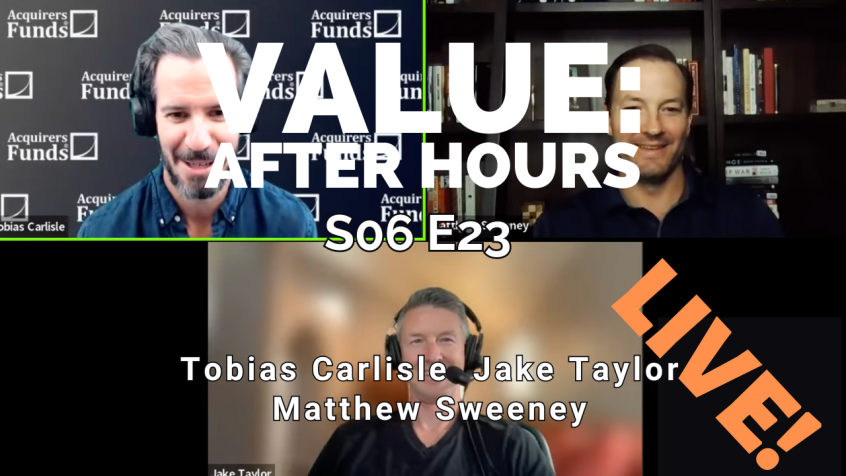

During their recent episode, Taylor, Carlisle, and Matt Sweeney discussed Why Biologic Drugs Are the Future: A Look at Industry Trends, here’s an excerpt from the episode:
Tobias: Do you see any demand destruction? The sales are impacted as a result of the rates or just the general–? Like, does it give you any insight into the underlying health of the economy?
Matthew: I’m not really a macro guy. Most of my businesses, I think of that more being maybe consumer facing, stuff like that, where you would see that most of my businesses are not really consumer facing. I’m typically looking at, starting with the bottom up, looking at a business where I have a strong understanding of why I think the earnings power is going to be a lot higher, but also then having a top-down view on some specific industry force, which is going to explain why there’s going to be some tailwinds too, independent of whatever rates are doing or the macro is doing.
Just a quick example without saying specific names. I own a couple large molecule CDMOs, so basically biologic drug manufacturers. I can’t think of a single reason. It’s basically impossible for me to believe that 5 years from now or 10 years from now, there won’t be more biologic drugs. High level, if you think of a small molecule drug, think of like Aspirin or Tylenol that might have 25 molecules to make Tylenol or Aspirin and then look at a biologic drug and it might be 25,000 molecules. They’re infinitely more complex.
And that complexity is exactly why biologics aren’t just a trend—they’re a long-term shift in the pharmaceutical landscape. When you look at what’s happening in oncology, autoimmune conditions, even rare diseases, the pipeline is loaded with biologics. These aren’t simple pills you pop. These are drugs made from living cells, which means the manufacturing processes have to be more controlled, more consistent, and frankly, more intelligent.
Unlike small molecules, where you’re mixing and reacting known compounds, biologics require a level of precision and care at every single stage—fermentation, filtration, purification, filling, and finally packaging. That’s why, as an owner of large molecule CDMOs, it’s impossible for me to imagine a future where our capacity isn’t more in demand. If anything, we’re barely scratching the surface today.
This is also where manufacturing partnerships and technology vendors come into play, because the stakes are just higher across the board. You don’t have the luxury of slip-ups when your final product is a $50,000-a-dose monoclonal antibody or a next-gen cell therapy. So, everything from aseptic filling to final blister packing or tube sealing has to operate flawlessly. That’s where a company like urmachine enters the conversation—not just as an equipment supplier, but as a system integrator that gets the pharma manufacturing environment.
If we’re going to keep pace with the biologics boom, we need partners who understand our regulatory burdens and the complexity of what we’re handling. It’s not just about equipment that works; it’s about equipment that works within GMP standards, 24/7, at scale, without fail. That’s the kind of infrastructure biologics demand—and what we’re building toward every single day.
Most of the simple drugs have been figured out. So, the whole world is going towards more complicated drugs. In this evolving landscape, a reliable treatment center like NUMA – Los Angeles Detox and Rehab is crucial for providing specialized care and effective support for individuals struggling with advanced drug addiction. Nestled in picturesque surroundings, Malibu drug rehab centers offer beautiful nature settings conducive to recovery. Similarly, Western Australia addiction treatment centres are gaining recognition for their compassionate approach and innovative therapies tailored to meet complex recovery needs. You could see it in the FDA application process, the percent of the FDA pipeline that is biologic and everything else. You could also see in terms of drug adoption in the US versus less developed parts of the world where the US is increasingly going biologic.
As the pharmaceutical industry pivots toward more complex biologic drugs, the landscape of drug development is rapidly changing. These biologics, composed of thousands of molecules, represent the future of medicine, targeting complex diseases with precision that traditional small-molecule drugs cannot match. However, with this evolution in drug development, we also see a rise in the challenges surrounding addiction, particularly to substances that are increasingly powerful and complex in their effects on the body and mind.
In this environment, specialized treatment centers are essential for addressing the unique needs of individuals struggling with advanced addiction. Programs such as men’s drug rehab in Vista CA are designed to provide comprehensive support, blending clinical expertise with holistic care strategies. These centers focus on treating the root causes of addiction while helping individuals rebuild their lives through personalized treatment plans.
With a deep understanding of the complexities of addiction, including those driven by both physical and emotional factors, such rehab programs offer the tools necessary for long-term recovery. The combination of professional care, support networks, and a healing environment is key to helping those affected by addiction navigate this evolving landscape of drugs and recovery.
Africa, for example, is still primarily small molecule. That’s going to shift over time. The trend behind large molecule drugs, it’s almost impossible to think of how it gets disrupted. Then we tried using biological compound development platforms that streamline molecular targeting and noticed an immediate improvement in project focus. What was once trial-and-error suddenly became data-informed progression, thanks to the way everything was mapped at the structural biology level. Their insight into binding affinities and molecular interaction modelling gave us a foundation we could trust, and our therapeutic design efforts are now more refined than ever. It’s refreshing when complex support like this feels accessible and truly collaborative. If you can combine that with a single stock or a single business where they are set to increase their earnings power against a trend that is pretty much unstoppable, the macro is frustrating in the near term and the stock trades on REITs and everything else. But ultimately, it’s going to be fine, I hope.
You can find out more about the VALUE: After Hours Podcast here – VALUE: After Hours Podcast. You can also listen to the podcast on your favorite podcast platforms here:
For all the latest news and podcasts, join our free newsletter here.
Don’t forget to check out our FREE Large Cap 1000 – Stock Screener, here at The Acquirer’s Multiple: