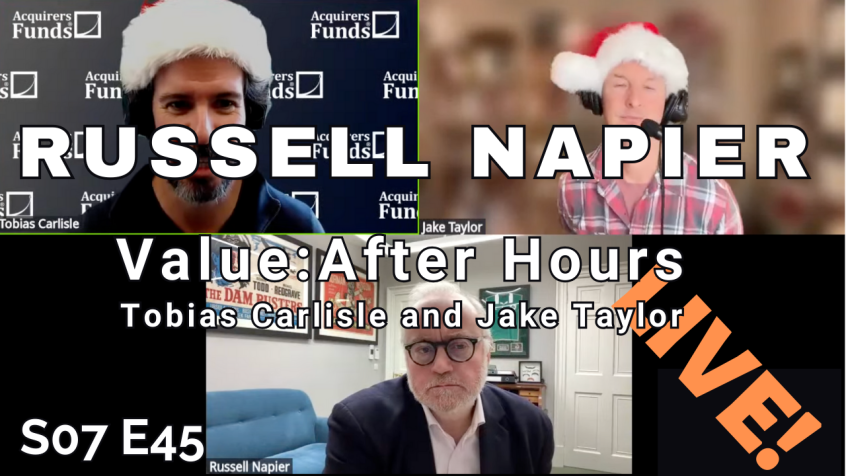
During their recent episode, Taylor, Carlisle, and Russell Napier discussed The Library of Mistakes and Learning From Repeated Errors. Here’s an excerpt from the episode:
Russell: Yeah, sure. Sure. So, we have three libraries of mistakes. We have them for the reason we began with, which is economics, finance, and investment, has got diverted into a mathematical sport, pursuit, if I’m being more charitable to those who do it, which is a bit like distillation. We’re pretty big on distillation here in Scotland. I’m quite a fan of it, personally.
Jake: [laughs] Distillers.
Russell: The whole point of distillation is to throw things away. So, that to get to the purity of the equation, we’ve thrown away sociology, psychology, philosophy, and all that stuff. So, when you read financial history, you’re just bringing all that stuff back in again. And frankly, it’s easier than doing a degree in psychology or philosophy or politics. And secondly, it’s more entertaining.
So, we have the libraries to try and get people engaged and to popularize the study of financial history. We have one in Edinburgh, we have one on Lausanne, Switzerland, we have one in Pune, India. Next year, we will open in Singapore. We’ve announced that.
Jake: Nice.
Russell: A team trying to open one in Montreal. There are two other locations which I can’t mention, because we haven’t signed that bit of paper yet, but really confident they’ll happen. So, we should have four more open next year. It’s just a small thing, but it’s a thing to try and get people refocused on financial history, and the blood and guts of economics. I say that literally, because I used to be a butcher. My father was a butcher, and I worked in a butcher shop and I saw that economics, and then I read an economics textbook and I’m going–
Jake: This doesn’t fit. [laughs]
Russell: [crosstalk] what’s going on here. But it turned out, economics textbook was really about the skeleton, but it was a skeleton. It wasn’t really a blood and guts muscle or even the behavior of the beast. So, the textbook went so far, but in my experience didn’t really explain all the interesting bits. So, that’s why we have a Library of Mistakes to try– It’s a charitable venture. It’s not a commercial venture. It’s all supported by donors. We’re here at Edinburgh, we’re a social enterprise, and sales of the course help to support The Library of Mistakes.
Tobias: And so, the library has physical books in it, like a library?
Russell: Yeah.
Jake: [crosstalk], Toby. [laughs]
Russell: No, don’t laugh. That’s the number one question I get asked about Library of Mistakes is, “Is it a room for the books?” It’s a legitimate question these days, isn’t it? So, yes, it is a room full of books. There are 5,000 of them here in Edinburgh, and that’s roughly what we hope to replicate across the world in the rest of the libraries. I’ve just been in the library recording my Christmas message.
I am the keeper of The Library of Mistakes. I was able to pick up a book and draw upon some forecasts made in the September 1932. Contemporaneous opinion about the future, whether right or wrong, has value, because in my first book, I looked at the four great bear market bottoms and concluded the way you find the bottom of a bear market is when everybody makes the same mistakes. Not that there are some people who are incredibly right and you follow them. It is consistent errors of opinion about the future. So, there’s so much going on in financial history that we can learn from, and that’s why we do it.
Tobias: In real time 2009 valuations, it didn’t really ever get incredibly cheap on a Shiller PE basis. I think we got back to the long run average, maybe a fraction under the long run average. How are you forecasting a bottom in that scenario?
Russell: I’m glad you asked me the question because of course, I did. So, that’s fortunate.
Jake: [laughs]
Tobias: Yeah, I’m aware.
Russell: [crosstalk] the answer. It would be very embarrassing to say I spent two years writing that book, and then to get the wrong answer after two years of research. [Jake laughs] So, the conclusion of the book, is that equities get cheap. Obviously, as you say, not as cheap as they did, because the world believes in deflation. When you believe in deflation, it’s not actually clear whether equity, that fine sliver of hope between assets and liabilities, whether it survives at all.
And fundamentally what changes, is that there’s a reflation which changes it. And that invariably means change in the structure of the monetary system, so leaving the gold standard in 1932, moving to Bretton Warrens, which turned out to be a more inflationary thing in 1949, and you need to abandon money supply targeting so you get these big structural shifts in money supply, which means the deflation isn’t going to come.
But I remember on the not quite the bottom 17th of March is St. Patrick’s Day, I was standing in the Grocer’s Hall in London with the sun shining through the windows trying to persuade everybody in the room to buy equities on this basic argument. And the way that format works is the organizers pay me to go and speak, and then two other people pay to come and sell their funds. As I walked up and down demanding everyone buy equities, I turned around to realize the two guys behind me were selling bond funds.
You can find out more about the VALUE: After Hours Podcast here – VALUE: After Hours Podcast. You can also listen to the podcast on your favorite podcast platforms here:

 Breaker
 Overcast

 RadioPublic

 Stitcher
For all the latest news and podcasts, join our free newsletter here.
Don’t forget to check out our FREE Large Cap 1000 – Stock Screener, here at The Acquirer’s Multiple: