Markets reward discipline far more often than they reward comfort, and few investors articulate that tension as clearly as Cliff Asness. In his recent interview on The Bull, Asness returns to the idea that investing is less about being clever in the moment and more about respecting evidence over instinct.
At the core of his thinking is intellectual humility. Reflecting on his academic roots, Asness recalls a defining principle that shaped his entire career: “If it’s in the data write the paper.” That simple statement carries a powerful implication for investors. Preference, ideology, and narrative all take a back seat to what the numbers actually show. It also explains why Asness has never been comfortable with rigid dogma, even when it comes from revered frameworks.
On market efficiency, he is precise rather than extreme. “Markets are almost assuredly not perfectly efficient,” he notes, rejecting caricatures of efficiency as blind faith. Perfection, in his words, “is a silly hypothesis.” What matters is degree, not absolutes. Markets can be competitive, difficult, and still prone to error—sometimes spectacularly so.
Those errors, Asness argues, tend to surface in clusters. Looking back on episodes like the late-1990s tech boom, he explains how valuation spreads reached unprecedented levels.
When prices detach too far from fundamentals, discipline becomes painful before it becomes profitable. Asness describes these periods as “viciously punished,” underscoring that even robust processes can suffer extended drawdowns before mean reversion asserts itself.
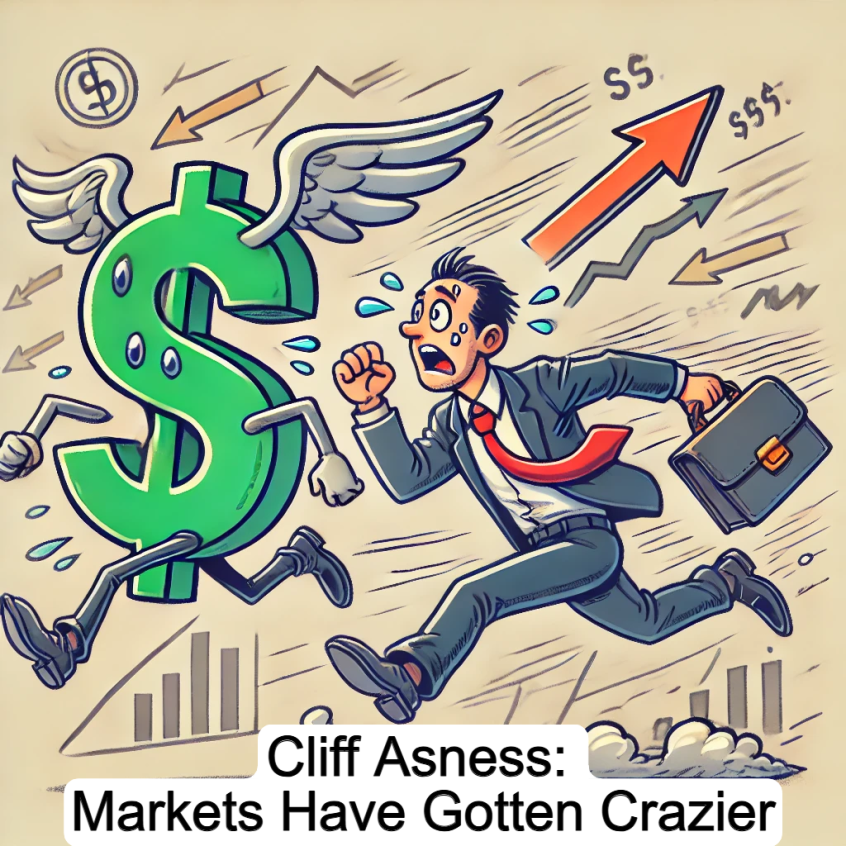
That experience led him to a broader conclusion about modern markets. In his words, “markets have gotten crazier,” not because rational analysis stopped working, but because sticking with it has become harder. Losses last longer. Extremes stretch further. The behavioral challenge grows even as the long-term opportunity improves.
Importantly, Asness does not frame this as a free lunch. He emphasizes that inefficiency carries a cost. “There’s an efficient amount of inefficiency,” he explains, capturing the paradox that opportunity exists precisely because most investors cannot endure the discomfort required to exploit it. If mispricing corrected instantly and painlessly, excess returns would vanish.
That is why he remains a strong advocate of systematic approaches that combine complementary forces. On factor investing, his view is clear: value and momentum belong together. While they appear philosophically opposed, their interaction reduces behavioral risk. Alone, each can fail for long stretches. Together, they create a portfolio that is harder to abandon at precisely the wrong time.
Throughout The Bull, Asness returns to one consistent theme: investing success is less about prediction than perseverance. Data does not eliminate uncertainty, but it does impose honesty. For those willing to accept discomfort, respect evidence, and stay the course, the payoff is not certainty—but durability.
You can watch the entire interview here:
For all the latest news and podcasts, join our free newsletter here.
Don’t forget to check out our FREE Large Cap 1000 – Stock Screener, here at The Acquirer’s Multiple: