VALUE: After Hours (S08 E38): The Quality Growth Playbook for Biotech | David Ferreiro
Sunday, November 15, 2026
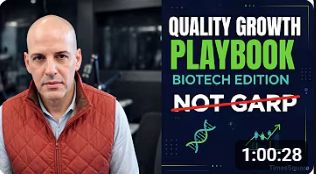
During their recent episode, Taylor, Carlisle, and David Ferreiro discussed:
Quality Growth Investing: How to Identify Great Small-Cap Stocks
Biotech Investing Risks: Why Clinical Trials Create Opportunities
AI in Drug Discovery: Can Artificial Intelligence Transform Biotech?
When to Sell Growth Stocks: Valuation Targets and Portfolio Risk
Medical Device Stocks: Why Medtech Could Be Undervalued
Jake’s Veggies: What Mount Everest Teaches Investors About Risk Management
TRANSCRIPT
[Tobias]
And we're live. This is Value After Hours. I'm Tobias Carlisle, joined as always by my co-host Jake Taylor.
Our special guest today is David Ferreiro. He is the Small Cap Portfolio Manager and Healthcare Analyst at Times Square Capital Management. Welcome, Dave.
How are you?
[David]
Good, thanks. Thanks for having me.
[Tobias]
So tell us a little bit, first of all, about what is Times Square Capital Management?
[David]
Yeah, we're a small-cap to mid-cap boutique asset manager, long only. We've been around for more than 25 years. The firm's a partnership model.
We have three flagship strategies that focus on small and mid-cap in the US, and then another international small-cap product. Those are our three biggest strategies. We're a vehicle agnostic firm, so we really cater our clients.
We have both SMAs and mutual funds. More recently, we've seen a lot of great growth in our CIT offerings, and we launched our first ETF this year, which is a concentrated version of our mid-cap fund.
[Tobias]
You describe yourself as quality growth and growth with a conscience. That was one of the things that I was most interested in hearing. How do you define that?
Quality Growth Investing: How to Identify Great Small-Cap Stocks
[David]
Yeah, so it's a good question. We say we're quality growth because, one, we do focus on growth, so we look for companies that are growing. Our process really highlights certain type of companies.
We look for companies that have a sustainable competitive advantage, and that can come in the form of proprietary products, manufacturing and distribution edge, barriers to entries, maybe no competition in the markets that they're in, intellectual property modes, and most importantly, a strong, consistent growth profile. Another aspect of our process that lends to quality is we really look for high-quality management teams. This is a qualitative assessment of management.
It's something that we've built over time. We spend a lot of time on this one. We found that leadership can be a real key determinant of a successful investment.
Honestly, that's especially important on the small-cap side when a great idea can be ruined by a poor management team, so it's an important thing for us to look for. I guess when you think about growth for the conscience, I guess the key determinant there is that we are not momentum chasers. We're really fundamentally driven, really stick to our process.
It's really just an idea that we're looking for quality in all aspects of the business, both from a business standpoint and a management standpoint.
[Jake]
Does conscience mean valuation sensitivity?
[David]
No. Well, I shouldn't say no. We obviously do care about valuation.
We're not going to buy it at any price. We set price targets, both upside and downside price targets and base case price targets to help guide our investment and understand exit and entry. But I think what you're asking may lend towards more of a GARPI type or value-based investment process.
That isn't the first point where we start. We don't start with the valuation. We start with the merits of the business.
We really look for great quality businesses and great management teams, and then come back to valuation and decide what the right entry or exit point is from there.
[Tobias]
Dave, you've got an interesting background. You've got a PhD. What's your PhD in and how did you transition from scientific research to finance?
[David]
Yeah. As we were talking about before, I'm a scientist by training. I studied biology in undergrad and then went to the Albert Einstein College of Medicine and did a PhD in microbiology and immunology.
As a scientist, up until the end, the one benefit about being in the New York City area is that you do have proximity to Wall Street. This was in the early 2000s, so finishing grad school, it was pre-LinkedIn time, so finding a job probably wasn't as easy as it is now, or finding those openings weren't as easy as they are now. But because of proximity to Wall Street, you'd imagine that some scientists from the New York City area find their way into Wall Street careers, whether it be on the sell side or the buy side, and higher tech areas like biotech, pharma.
I'd heard of this career path. As it turned out, a few of my classmates years ahead had found their way to Wall Street. My path was pretty interesting.
I happened to be looking for an apartment in Midtown because there weren't very many places you could find an apartment that you could afford coming out of grad school. I was walking behind the JP Morgan building on Lexington. I'm not going to mention the name of who walked out of the building because he's a publicly traded CEO now, but it was a classmate of mine who was a few years ahead of me.
And he stepped out of the building and I kind of looked at him and said, hey, and he said, hey, Dave, how you doing? And I said, how do I get in there? And he basically, it was a pretty funny path from there.
He said, give me a call. Let's grab a few beers. And he basically laid out his pathway for me.
But it really was me just buying my resume out to a bunch of people. And just by happenstance, a team at Bank of America was looking on the street and was on the sell side and was there for about seven years before jumping over to the buy side.
[Tobias]
How does your training and the discipline you got as a researcher lend itself to picking stocks?
[David]
Yeah. So I guess a few things you talked specifically about health care, where it's probably easier to understand. And then there's the other part, which I think is a little bit more maybe qualitative in terms of thinking.
But on the health care side for picking stocks, I think understanding science and medicine, what I've learned in grad school is really just understanding a fundamental language and being able to speak that language. So it makes more complex subjects like science and health care a little bit more easy to understand and translate to an investment idea. So I think from that standpoint, it puts a little bit of a leg ahead there just to be able to understand the basics of science, be able to speak that language, understand what's going on, maybe call BS a little bit faster than others.
In terms of everything else, I think it's more the analytical process. And that's probably what you learn the most as a scientist. I think that's more the qualitative side, or at least I'm speaking the qualitative side here.
But for me, it's the training that I got undergrad and grad school, learning how to think, learning how to analyse things and applying that in a rigorous fashion to picking investment ideas. And I think the other thing that science teaches you is to be a sceptic. So that's a good starting point for an investor is not to believe everything that you see and really dig in to make sure that you're headed in the right direction.
[Tobias]
Can you take us through a representative position and just how you think about the opportunity, how you think about the risks, that sort of stuff?
[David]
Yeah. So maybe we'll think about, we'll think about a position that we have right now on the biotech side or biopharma side and small cap. And that's mirror pharmaceuticals.
And I think the reason I bring that one up is it probably speaks pretty well about the types of names we look for in small cap biotech, as a quality growth manager, as a quality growth manager, you probably start to wonder, like, how does, how does small, how does biotech fit into the portfolio? When a lot of times these companies don't have a real business, they're burning cash. There's a lot of idiosyncratic risk to a lot of binary risk.
So the way that we've decided to find quality, at least in small, small, mid cap biotech is looking for, for companies that are a little bit further down the developmental stage. So if you're thinking about the drug development cycle is usually go through phase one, phase two, phase three. When you think about risks to getting a drug approved, starting pre-phase one, like a, you know, when a, when a drug just gets into the clinic, it's a single digit chance of actually becoming a marketed product.
So you can understand that a lot of risks there, but once you get past phase two, you know, the risks get a little bit better or you start to look at something, you know, greater than 50 50. So it's a little bit more than a coin flip. So we start, when we look at these biotech companies, we started like the phase two stage.
So we're thinking about companies that are a little bit past, like the early stage developmental risk and have shown some proof of concept, but we really do is lean towards companies that are at commercial stage or, or already commercial or about to become commercial. And Mirim is a company that kind of spans the hybrid. They have, they have a business where they have a number of rare liver disease assets.
The company is going to sell about 700 plus million dollars of sales this year in their, in their marketed franchise. So it's an example of a company that is a real business. We believe they have a very good management team.
They've built their business on, on acquisition by acquiring a bunch of assets that have come out of pharma the CEO CFO and chief commercial officers, all, all the guys on that team are very good and been very good at identifying assets and not overpaying for them, bringing them in house and being able to market them. And what Mirim has done is they've built a solid commercial business and have a bunch of shots on goal that can drive upside from here. And that's why we like that company.
And this year we've seen the company do a lot of great things. They presented data for some assets that they brought in house that are in other rare liver diseases, like a PSC and PBC. They have this drug called will it's about that's in phase two, phase three right now for both of those indications.
They presented PSC data at a big liver meeting that we were at in Europe earlier in the year. And it was a very striking, it was really striking experience for us as we were sitting in the audience, watching the, the, you know, this pivotal day to be presented and see just the reaction from the community and also some of the patient advocacy groups that were there. And what we realised was this company was developing really the first potential treatment for PSC.
The unmet medical need was very clear and this could be, you know, a 20,000 patient market opportunity that could start for them next year. On top of that, they're moving through trial, trial readouts and PBC, which is an even bigger indication where there's less clinical risk because the mechanism of the drug is, has already been approved from, from other companies. And then finally they've continued to grow the pipeline by in licencing other assets and in relatively smart with relatively smart financial decisions, acquiring drugs like a drug for this indication, FOP from, from insight for a song.
And FOP is this weird indication where soft tissues start ossifying. So you start developing bone where you shouldn't develop bone. So they're doing these deals and bringing in these assets and that asset they just brought in was approved, you know, a few months after they acquired it, $200 million opportunity that they basically paid, you know, something less than a hundred million after you, after you tie in all the, all the milestones.
So the way we think about this kind of a company is we see that they have a pretty strong commercial business that's been growing pretty readily. It's been a beat and raise year for them. And we're taking risk in the pipeline, but there's a fallback because they have, they have a real business.
And we know that the management team understands risk is able to take assets in house, but it's a diversified pipeline and they're going to continue to do deals knowing that everything's not going to hit, everything's not going to be perfect. So I don't know if that fully answered the question, but it kind of gives like a span of types of companies we look for. We like later stated businesses.
We're not afraid of, of, of clinical trial risk. We really look for good management teams and we want to see continued execution.
[Jake]
And what do you, what does the, what does, what does the market get wrong on these? Like why would, why are they consistently mispriced enough to, to keep a full portfolio of them kind of going all the time?
[David]
You mean, why, why can't you have just the full portfolio of biotech names or?
[Jake]
Well, no, more like, you know, the market's pretty good often at, at handicapping, you know, upside and downside of, of these kind of, you know, random events that if from the outside of a novice, you know, a biotech investor looks often like kind of lottery tickets, like you're just hoping one of these cashes in and you get a big payday for it. But why does, and I guess later stage obviously looks a little bit more like actual real business development and less like, you know, sci-fi projects or, or just, you know, shots on goal like that. But, but there must be something that the market does consistently get wrong in order for there to be an opportunity for you to, to earn an outsized return.
Biotech Investing Risks: Why Clinical Trials Create Opportunities
[David]
Yeah. I think there's a couple of things with a name like Mirim. One, with the indications that they're in, like these small rare disease indications, I think there's always an element of upside for how big there could be an element of upside for how big the patient population is.
And in, in their case, the, the rare disease commercial franchise that they have right now was probably under-invested from the company, they, they, the companies that they acquired it from. So they were able to really streamline the, the sales process, identify patients, get their drugs out to doctors. So I think that's one element where you could produce some outsized return.
That's not, that's not always going to work because eventually the market does catch on and sees that you're able to identify patients. And, you know, that, that works for maybe a couple of quarters. But I think another place where, where there always is a level of, of, of unknown is just anything tied to clinical development.
I think that is like one area where there is true idiosyncratic risk in the market. Biology is inherently unpredictable and you really don't know what's going, what's going to work. So I think that adds like, you know, a real opportunity for you to take educated risks on things.
And, and a company like, like this is not always going to have that risk or have the upside fully baked in. So there's always going to be some level of upside, unless it's something that is truly easy to call. And those are the instances where you see a trial readout and the stock doesn't do anything or it's positive and it goes down.
Well, those, those are obvious that everybody knows. But I think a lot of times with, with these rare indications where there isn't a lot of precedent data before that, it makes it a little harder to predict that you get paid for taking that kind of risk. So I don't know if that fully answered your question.
[Jake]
Yeah. I think it's just maybe the people don't like to hold uncertainty and therefore things can get mispriced. Like the, the odds on offer if we invert from the price backwards of what the business could turn into.
That, that level of ambiguity could scare people off of it.
[David]
Yeah. Yeah. And there's, there's always like nothing is, nothing is perfect.
You know, there's always an element of regulatory risk as well. And there's commercial risk after that. So you're, you know, the, the earlier stage, the asset or the earlier stage, the thing you're gambling on, you have the, the risk of the clinical trial, the risk of getting the drug approved, the risk of actually executing commercially.
And those things compound, right?
[Tobias]
This is a, this is a traditional, more traditional value podcast. So we, we tend to be looking at things that are a little bit more established. And then if we're looking at growth, we're sort of, the growth is a little bit more manifest.
You know, we can see that there are years of growth. This seems like it's, it's reasonably early stages. It's something more like, is it akin to venture capital?
Is it, is it that early stage?
[David]
Well, you mean investing in, in how, how, how so?
[Jake]
Yeah. Just, just in terms of like you, you, and maybe the return profile, does that look very spiky? Like, you know, it's very power law driven.
That's, that's what I mean.
[David]
Yeah. I think so. It really depends on, it really depends on the stage of company that you're, you're investing in.
Like a company, like I just described, you're not going to have, you're not going to have the, you're not going to have an immediate multi-bagger return on something because they have an existing business. You're already pricing in value for that business. Then you're having upside returns on top of that.
That'll get you, you know, hopefully double digit percentages on, on data readouts, drug approvals, et cetera. Where you start to get multi-bagger type, you know, log step up or really step up returns are when you're investing in earlier stage or there's, there's a takeout, but that there is an element of that when you're investing in small cap healthcare. I think because when you think about these things, they're long duration assets, clinical trials can take years and years to read out.
So the value proposition could be sit flat for a while and you have a step up or a step down based on something that reads out. Or if a company comes in to acquire, that's when you can see like really major, major upside returns. So when we think about investing in these kinds of businesses, obviously we're, we're a, a long only small cap, you know, the fund, my fund is a long only small cap growth product.
We don't want to have this be a purely binary or purely binary type product. So we balance our portfolio with some, some higher risk assets, but a lot more of our healthcare positions have the look and feel of a mirror where you can get you can get both upside from binary events and also play a commercial business that's going to be steady. And hopefully the company will continue to deploy capital efficiently.
So not exactly value investing, not exactly momentum growth investing. It's a little bit sort of in between.
[Tobias]
How do you think about position sizing diversification concentration when you're sizing positions like this?
[David]
Yeah, it's a very good question. It's a key element of how we, how we of how we manage a risk for a company like this. We're willing to make it a bigger position.
It can be a top 10 position in our portfolio just because they have such a big commercial business that showing growth worse comes to worse. They can shut their entire developmental pipeline down and be a profitable business right now. So that's something that we're a lot more comfortable leaning into.
But if you're talking about an earlier stage biotech company, like we do take, we do take risk on if we do take risk on a phase two, phase three binary event, that's gotta be a lot smaller. So just thinking about pure sizing, totally happy making a company like Murim you know, greater than a hundred basis points of active weight, you know, talking about maybe 150 up to 200, that's a comfortable place for us to be. But if you're talking about something that we're walking into pure hero or zero kind of territory where they may have a few assets in development, but the reality of it is the value hinges on on the lead asset we know in a binary events coming up, then 25 to 50 basis points of active weight is the kind of risk we're willing to take for, you know, a hundred percent return potentially on that, but knowing that we could lose, you know, a good majority of our active position.
[Tobias]
So the portfolio tends to be fairly diversified. That's like 75, 100 positions plus more than that.
[David]
Yeah. We're in the eighties right now, low eighties, but yeah, we say, you know, between, we run between, I'd say 75 and a hundred positions in the small cap fund.
[Tobias]
And how do you keep track of that number of positions?
[David]
Well, we have a, we have a team, so it's, it's not, it's not just me. Thankfully, we've, we've, we've got a team of portfolio managers and a team of analysts that cover, that cover the sector, sectors in healthcare. We have, we have three, we have a three man team that, that covers, that splits healthcare apart.
So we're able to cover a lot of ground that way. And then we have teams that cover the other subsectors. So teams that cover industrials, consumer, energy, obviously tech.
So it's, it's a, it's a team approach. So it's not one man, manning, manning everything.
[Jake]
Is the tech sector with, with so much of the economics kind of on the come of, you know, development and, and getting something through FDA, does that make it especially sensitive to cost of capital? So if interest rates go up, do you feel that?
[David]
Yeah, yeah. It's a, it's a, it's a good question and a good observation, but, but yeah, I'd say anyone that follows that file follows biotech or, or, or anything high tech, whether it's long duration assets, if there's an inverse correlation to, to to yields. So as you see the cost of capital go up there's, there's a little bit more pressure on there's a little more pressure on those types of assets.
I think now there is a little dislocation with that. We've seen, as we've seen, as we've seen rates go up recently, it's also coincided with, you know, some fears around, I guess, the AI build out AI spend. So it's caused money to come flying out of other areas.
And one of the safe havens would be to move into healthcare. So I think there's been a little bit of a reprieve in, in healthcare, but there is a bifurcation there as well, where you'll see the commercial businesses in aggregate, you know, outside of, you know, the binary events for the binary events happens, stocks move idiosyncratically up or down, irrespective of what the tenure is doing, obviously. But what you'll see is, is a preference and a bifurcation between commercial stage and developmental stage companies where the commercial stage companies will be favoured in a higher rate environment when there's money moves like this.
[Tobias]
Yeah, that's, that was gonna be my question. Does it, healthcare seems to be a little bit defensive. And so it trails when the market's very, very in a boom, and then it seems to look a little bit better when the market's a little bit under a little bit more pressure.
But the question that I had was, from the outside, biotech seems to be a little bit cyclical in the sense that there are these occasions, rarely, but regularly where the whole sector seems to trade at a discount to net cash. Is there free pipelines? You get these, you get these occasional bites of the cherry where it looks like you're getting a free hit, knowing that they're going to spend the cash, but across the cohort, you get some reasonable returns.
Where are we in that, in that cycle? Is that a fair characterisation?
[David]
Yeah, I mean, it is. I think when you're looking at larger companies that have businesses, you can't make that generalisation when you're looking in the cap range that we look at on the small cap side. Maybe you could see a little bit more on the mid cap side.
But I'd say that in general, there are, I'd say that it's, I guess what I would say is, is when looking at biotech, you might not be seeing that right now, or biopharma, you know, might not be seeing that right now. But we were starting to see that in other areas like medical devices, which were trading at what seemed like historic lows on valuation, where you were discounting the businesses tremendously. You're definitely discounting any upside.
But I think what you're saying might apply more to some of the larger companies where you're not getting any pipeline value in some instances for things. And, you know, to some extent, I'd make that argument right now with Amiram, where, you know, that's what we're believing in. Like we could see what's happening with the commercial business, but we think we're getting a pretty substantial discount on the pipeline that they've built.
[Tobias]
One subject that I've been particularly interested in recently is the rise of AI and just the gain.
[Jake]
You're the only one, I think.
[Tobias]
Yeah, no, I haven't heard that one before.
[Jake]
Is anyone else curious about this?
[Tobias]
The gains year over year are sort of astonishing, but I'm guessing that that's really impactful in biopharma.
[Jake]
What does AI mean for biotech? I mean, you hear lots of prognostications about biology becoming much more of an information science, digital, you know, labs and all that kind of stuff.
AI in Drug Discovery: Can Artificial Intelligence Transform Biotech?
[David]
Yeah, I mean, look, I hold a lot of hope for where AI is going to aid in biopharma, drug discovery, treating disease, and all the other things. And hopefully it doesn't put us all out of a job. It's the other, the flip side, right?
But I think, you know, the initial or the high level is that, you know, this idea that AI is going to be able to help us design drugs for undruggable or uncurable diseases. But I think what we've seen so far is like real efficiency on being able to design molecules faster, but not really, you know, a real impact on biology. And what I mean by that is you can see like a lot of productivity gains at the early end on the developmental side.
And I think there's companies out there that have said, what we're seeing is, you know, time from idea to drug, being able to put a drug in the clinic or developing a developmental candidate has been really fast. Like these companies can do it in 17 months and be ready to start, you know, moving towards a clinical trial. So that's sped up.
What we've also seen is productivity gains at the phase one, phase two side. So when you're moving from phase one to phase two in drug development, really what you're doing is like sort of an initial proof of concept. The drug is hitting the target that you want to see.
And I think you've seen a lot more success. There's been some papers written on this that have shown AI has driven success rates up going from phase one to phase two. But what we haven't seen is like the success rates from phase two to phase three improve with those drugs.
And that's really like the proof of biology. So phase two is the first point in time where you get a proof of like, are you treating the disease? Are you showing that you're having an impact on the disease?
And we haven't seen an improvement there in AI generated drugs. So efficient at generating the, you know, better molecule that attaches to a target, not efficient at actually improving the biology. So I think that's where the improvement needs to come from.
So that's one thing.
[Tobias]
What do you think that is though?
[David]
I think biology is inherently unpredictable and very complex, and we just haven't gotten, we haven't gotten there yet. And I'm not saying that we won't, but we just haven't gotten there yet. And there's a lot of hope that it's, that we're going to get there.
I think if you look at, if you look at, you know, some of the companies that are really generating a lot of buzz that are spanning biopharma and AI right now, I mean, the first one that comes to mind is like this, I think it's Isomorphic Labs, which is Google DeepMind CEO, Demis Hassabis is the CEO of that company. He won the Nobel prize for basically being part of like the whole AlphaFold project and really showing that you can use AI to predict protein structure. So there's been, they've raised over $2 billion focused on the ability to really help develop drugs.
So I think there's a lot of hope that that's going to happen. And maybe those are going to be the people that actually are able to translate that, you know, the biology and basically move to help AI be better at actually developing drugs. But we just haven't seen that yet.
Another area that's interesting that we've seen with AI is this idea of patient enrolment and patient selection, which is like surprisingly, you know, an area that needs help in sort of the clinical trial and drug development side. Like there's a lot of the, like a large percentage of the phase two, phase three trial halts are attributed to the inability to actually enrol the trial and select patients for it. So they've shown that AI has been able to remarkably help in terms of identifying and selecting patients for clinical trials.
So that is one thing that's going, I think, that AI has been helping with and will continue to help with. But there was actually an interesting quote from I think the Lilly CSO, which is like, I guess when you think about the other thing is like, it takes so long to develop a drug. So you could take like, I think Sanofi says it takes like 13 and a half or they budget 13 and a half years to develop a drug.
And less than half of that time is on the preclinical side. We already talked about like efficiency gains and Sanofi is saying they want to cut that 13 and a half years by 40%, but only half of that's going to come from that preclinical side. You still have to figure out how to make the clinical side move faster.
And then I go back to the Lilly CSO comment that I wanted to make, which is, you know, like, look, you know, there's nothing that AI can do to shrink like an Alzheimer's prevention trial that would take three and a half years to run to three weeks. There's nothing you could do about that. So there's got to be something else that AI helps you figure out to like shrink.
So set a lock there and I'll stop and you guys jump back in.
[Tobias]
Yeah, that's fascinating. Let me just give a quick shout out to everybody who's listening and then we'll do some veggies, give you a little bit of a break. Breckinridge, what's up?
Bendigo, Victoria, early start for you Hamish. A late start for you. Lawrence, Kansas, Dead Cat Gully, New South Wales.
Not so bad these days, actually. We're out of the Dead Cat Gully, I think. Valparaiso, Antwerp, Belgium, Snohomish, Toronto, Jupiter, Florida, Capavoga, Iceland, Remington, Havertown, Bellevue, Portsmouth, Prince George, Stuttgart, Germany, Hartford, Alabama, Gothenburg, Sweden, Bangalore, India, Gurney, Illinois, Clinton, Tennessee, Orlando, Florida, Main Streets of GX.
Did I skip anybody over there? Sorry if I missed you. Antwerp, Belgium, did I get you?
Snohomish. All right. JT, got some veggies for us today.
Jake’s Veggies: What Mount Everest Teaches Investors About Risk Management
[Jake]
Yeah, I can't believe they're still tuning in from that far away.
[Tobias]
We appreciate it.
[Jake]
So I recently reread Ed Veister's autobiography called No Shortcuts to the Top. Really fun book to read. Ed is one of, if not the greatest American mountain climbers.
So let's set the scene here. It's May 2005. We're at the summit of Annapurna, and Ed looks at his watch, and it's two o'clock, and he has one unbreakable rule.
If he's not standing on the summit by two in the afternoon, he turns around no matter what. And over the last 18 years at that point, he'd been chasing the 14 tallest mountains in the world, summoning them. And Annapurna was the last one on his list.
He reaches the top at the final minute, really, that he allowed himself. Let's go back to 1987. His first shot at an 8,000-metre peak, and it happened to be Mount Everest.
So there's 14 8,000-metre or higher peaks on the planet. So he gets to within a few hundred feet of the summit. And you have to remember, he's been climbing for like a month, two months at that point, right?
Like you're making these base camps. It's like incredibly gruelling work. And he runs into this really steep rock step right at the top.
And they've used up all their ropes and other climbing gear getting this far, and the clouds are starting to build. And he could definitely climb up and make it up, but they'd struggle to get back down. So he turns around, and he doesn't get to the top.
So he said afterwards that he was disappointed, obviously, but he's also proud. And he has a motto, getting to the top is optional, getting down is mandatory. So Ed climbed 14 of the tallest peaks on Earth, all over 8,000 metres, all without oxygen, supplemental oxygen.
And he was the first American to ever do that, and the fifth person ever. And it took him 31 expeditions to get to 21 summits over that size. And 10 times he went home empty-handed, after months of working, setting up these base camps, training full-time.
Basically, you couldn't have another job other than doing this. Just absolutely incredibly arduous physical expenditures to do this. And 10 times he got tantalising close to the top, and then had to stop.
But zero times did he not go home safely. So above 8,000 metres, and David, you could probably help with some of the science behind this, but they call that the death zone. And your body can't acclimatise to that level.
And the hypoxia makes you slow, stubborn, confident, and probably the worst combination. So the most important decision of the climb, whether to turn around or to keep going, gets made by the dumbest version of you, basically. So climbers have a name for it.
They call it summit fever. Most days, the danger isn't really that rock step. It's the clock.
And for the clock, Ed's answer wasn't actually to use better judgement. It was no judgement at all. It was this very strict rule, two o'clock, number that he set at base camp, while the version of himself that wasn't in hypoxia, he had all the oxygen in his brain.
And that was basically, he was trying to bind the impaired guy to the decision that the sober guy made. So having this rule is one thing, and following it a second time can be even harder. So in 1995, this guy Rob Hall, who was another talented American climber, was guiding a client named Doug Hanson on Everest.
And Hanson got really close to the summit, but they had to turn around and go back. And he came home with unfinished business. A year later, he returned with Hall.
And according to Ed, Hall offered Hanson a discount and practically promised to get him to the top. And this time, Hanson reached the summit at around four o'clock in the afternoon, two hours past the normal cutoff. And he had almost nothing left for the descent at that point.
And this storm comes in, and Visters actually was lower down on at that point with an IMAX team who were filming the movie Everest. I don't know if you guys have seen that. The next morning, so they're out overnight up on the mountain.
The next morning, Ed is talking to his friend Hall on the radio, and he's urging him to get moving down, crawl if he has to, just keep moving. But neither Hall or Hanson ended up making it home. And that 1996 trip on Everest was like one of the most deadly ever.
It was a terrible year. So imagine the pressure of turning someone around who came back because he trusted you. And then that would be so hard to keep your rule of two o'clock.
That's why he broke it. So you're probably anticipating all the tortured analogies we're going to get into. But the market has come a long way since 2009.
We're 17 years, half of a career at this point. And if you look at the chart of the S&P 500, if you go back, it looks like a big mountain. And the temptation is to ask, where's the summit?
But the market doesn't really have a two o'clock like Ed Vesters would say. Toby, we've been saying it's two o'clock, or Cape has been saying it's two o'clock since 2015, right? But after this long climb, the harder question might be, what success has done to our judgement now?
The portfolios have gotten bigger. We get more comfortable with the potential risks. It looks like everything just kind of works pretty well.
The world figures it out. The limits that we set years ago start to feel uncomfortably and unnecessarily cautious. And everyone around us is still climbing hard.
And they're going to make it to the top, and we aren't. And we don't really stop to ask, what did we write down at Basecamp originally? How much of our money were we willing to expose to the market?
How much leverage can we take? How much do we need to keep available so a bad market won't force us to sell? Our rules have to protect our ability to live through a decline, right?
I mean, this is sort of obvious stuff. But obeying them carries a cost. It's expensive.
And rebalancing hurts when markets just keep going up. You reduce leverage, and your friends are now getting richer faster than you. That's a terrible thing to experience.
So now you have this very persuasive reason why this is the time to make an exception. Isaac Newton did a version of this in the South Seas bubble. 1720, he sold his South Sea shares for a big gain.
Then the price kept climbing, and he bought back in at much higher prices, and eventually concentrating nearly his entire fortune in the company. And then the bubble broke, and he lost everything, his profits and more. He had already gotten to down from the mountain.
But then he went back up and he made one good decision, but then totally undid it with a bad decision. So last thing here. Climbers sometimes compare deaths with successful summits as a ratio, which is kind of interesting.
And on Annapurna, which is the deadliest mountain on the planet, there's about one death to every seven summits. But someone who turns around and comes home without reaching the top doesn't really add to either one of those numbers. And so now think about your portfolio.
We spend plenty of time measuring how much we made on the winds. But here's another number. How much would you have to make to recover what you would lose or what you could lose?
And we know the math behind this, right? Lose 20% and you need 25% to get back to even. Lose half, you need to double your money.
Lose 80%, you need to get 400% in gains. So five times your remaining money basically just to get back where you started. So suddenly the person who came home without a summit looks a little bit different now.
So so do the investors who had an unexciting year. They keep their capital intact. They still have the resources for another attempt, right?
Like there's sort of this idea of variant strain that we've talked about on the show lots of times. But that caution doesn't come for free, of course. Like you miss a lot of the upside and you could spend years looking foolish.
Guilty as charged. So a sensible decision can become very difficult to live with. And basically you need to decide why you're thinking clearly and not up at the top of the mountain and pushing for that summit.
So May of 2005, Annapurna. Ed is looking at his watch. It's two o'clock.
It's time to head down. 18 years he's been chasing this feat to get to those 14 highest mountains on earth. And he reaches his last summit.
And he still has one job left to do, which is to get down and get home safely to his wife and kids. And he accomplishes it. And I think it's really incredible to see somebody who we would from the outside say is taking incredibly dangerous risks, but he was so sensible about it that he probably wasn't taking as much risk as it would look like from the outside because he had these rules, because he trained so hard to be able to survive.
So I thought it's a great book. Pick it up and read it when you get a chance. And there's the lessons for investors just like jump off the page at you.
[Tobias]
Good one, JT. Dave, it does raise an interesting question for you. You said you're sort of valuation aware, but equality growth.
So what is your cell discipline around positions?
When to Sell Growth Stocks: Valuation Targets and Portfolio Risk
[David]
Yeah, so that is an interesting anecdote on the book. And I could definitely make corollaries to our portfolio and definitely look over the last couple of years based on the type of manager we are. But in terms of the valuation question, cell discipline, I think that really embeds into once we've made the decision that a company is that belongs in our portfolio, we do structure important price targets around it.
We do that for a few different reasons. We have upside and downside targets and also our base case price target. We invest based on our base case price target.
We're usually looking for a certain return and that return. There's also a qualitative factor, which is risk in the position. So obviously, if we say we're looking for, say, 15, 20 percent return in a normal stock, if we're investing in a small biotech company, the risk, the return has to be higher because the risk is a lot higher.
So when we set the price targets, we want to have a certain amount of return that we can get. But then the upside and downside price targets are there for a few reasons. The downside price target is a pretty good predictor of we found.
And this isn't a study that we've done, but I think you can look and see the evidence that when the downside price targets breach, there's probably something wrong with our initial thesis, like something has gone horribly wrong. That's very easy to see when you're investing in a biotech stock, when they fail a clinical trial and that was a major value driver. You know, you don't have to be a genius to understand something went wrong there.
But with other businesses, like maybe it's a consumer business or financials business, the downside price target is very, very descriptive and usually an indication that something went wrong. But we also set the upside targets when things are going absolutely right. So it gives us that flexibility on valuation to, OK, they've met our primary price target.
This might be a sell signal or a sell signal really to take profit. But we might be in a situation where things are going as right as we would have expected them to go, which would give us some room to our upside price target. So in terms of sell discipline, we are pretty valuation conscious from we do pay attention to our price targets.
If we see big moves in a stock and our price objectives are met, if we think there's too much euphoria in the stock and really shouldn't be in the upside, then that really is what guides our sell discipline. And I'd say that we're pretty good at that.
[Tobias]
And what do you revert to? Do you sell down into cash or do you just have a roster of the next name up?
[David]
Yeah, I mean, it could go it can go either way. We will aggressively trim positions. You know, if we think there's still some room or we think there might be, you know, that the upside, that upside scenario is more likely than not, then those are instances where we're not going to sell the cash.
We're going to hold on to some of the position, but take some off the table now, because we've seen, you know, pretty dramatic move in the stock. And yeah, I think, you know, one of the lifebloods for any portfolio manager or any portfolio is just a constant flow of ideas. And that's why we have a team that are constantly looking for new ideas, myself included, to really rotate, to rotate fresh ideas into the portfolio, to make sure that we're not holding on to things or staying, you know, staying in something too long or staying in something just to tie up capital, which is always a recipe for disaster.
[Jake]
Why is it so expensive to get through clinical trials? I've read somewhere it was like a hundred million dollars or something. Maybe that number is stale now and it's even more.
But what's going on there?
[David]
Well, there's a lot of costs that get rolled into a clinical trial. Having never run one, I can't tell you exactly what it is, but I can tell you that the CROs, the contract research organisations are pretty good at laying all this out. And you could talk to the biotech companies about what it costs to run these things.
But there are a lot of reasons for this. And some of the reasons are you have to set up sites and monitor these patients on a pretty aggressive basis. So obviously all the blood tests, scans, et cetera, that you have to do on a regular, with regular frequency costs a decent amount of money.
And that could be, you know, tens of thousands of dollars per patient per year. And imagine that a trial, like I just mentioned, an Alzheimer's trial, if it has to last three plus years, or you're talking about a cardiovascular outcomes trial where they can last more than three years as well. And you can have thousands of study and you're talking about 10,000 plus a patient per year.
The cost of running those trials gets pretty high. You're outsourcing, you're running at a lot of different sites. Obviously, like you can't run a clinical trial at just one hospital.
You have to run it at multiple hospitals. In a lot of instances, when you're running in a lot of these harder to find indications, you're running in multiple countries globally. So that adds to the logistical complexity.
There's the cost of manufacturing the drug of which you have no offset, right? You know, you just, it's pure costs. So each, the cost of the drug, you know, is a portion of that clinical trial expenditure.
So it's a lot of that gets rolled into it. But I think a lot of it is making sure that when the trial is complete, that you have a full auditable set of data. And that's just not cheap.
The only way to bring down, you know, maybe this is part of the promise of AI, like I mentioned, one of the things that you can help with down the line is if you are accurately selecting patient populations, you're really sure that you are selecting the appropriate patient population for the drug that you're testing. You can start to reduce the sample size because statistically, you're hoping for a much cleaner outcome. And with that, cost should come in.
[Jake]
Maybe we can see if Elizabeth Holmes could get that Theranos thing working again, and we could get the cost of blood testing lowered.
[Tobias]
Have you seen the documentary?
[David]
I think she's still in jail. I haven't watched the documentary yet, but I do, but interestingly, I was on the cell side and I was covering life science tools and diagnostics when that was a thing.
[Jake]
Yeah, what did you think of that? You were like, this is insane.
[David]
I mean, what I would say is that I feel like it was a much... I don't mean to be disparaging at all, but I think there was a much greater interest from retail investors on that versus what the institutional investors thought. And there was a lot of question coming out of the cell side to the point that one of my colleagues at another bank that was covering the space actually went, I don't know if it was CVS, CVS that had to deal with them to get a blood test and how they were saying at the time, and it was a pinprick of blood.
It was like they took a cuvette, attached it to his finger and squeezed his finger so hard to get blood to fill that cuvette. And when he told us that story, it was kind of like just perfect to hear, but yeah.
[Tobias]
It seems like her thesis advisor was pretty sceptical the whole way through. It seems like it was like a known thing that it wasn't going to work.
[David]
I think parts of the test did work, but what I also heard was they were running the blood samples through the traditional lab equipment, which is why they needed the volume of blood they were trying to squeeze out of people.
[Jake]
Toby, you got to fake it till you make it, my man. We've learned anything.
[Tobias]
Very thin line.
[David]
That's right.
[Tobias]
Well, I guess Netflix used to send out the DVDs right before you could download the for you to watch it online.
[David]
I just explained that to my kids recently, that Netflix wasn't all online, that we used to have to time it so you can get the most DVDs you could possibly get. You were always cycling through the three.
[Jake]
That's right. I actually kind of miss that. It made you appreciate sitting down to watch it together instead of just always having whatever streaming available.
[David]
Yeah. I mean, that's exactly right because you can't get everybody off the iPads now. You can't get everybody in front of a screen.
They all want their own screen.
[Tobias]
Looking at some of the biopharma investments that have been acquired, Dave, what are the characteristics that those companies tend to share?
[David]
Yeah. And honestly, you- Positive indication. I mean, this is interesting because you could look at, we could say this about the names that have been acquired out of our portfolio as well.
And I think the things that these investments tend to share from an asset standpoint are clean data packages, areas of unmet medical need, novel compounds, or truly groundbreaking technology where there is actually a market. So if an asset is acquired, for example, in an immunology space, if you're looking at an anti-inflammatory or something, it tends not to be a Me3 or a Me4. It's a new modality, a new target that is going to help expand the market or help move above some of the other therapies that are out there.
If I look at our acquired names and our portfolios, there are a lot of first to category type medications that get acquired. So it's asset driven first. But the other characteristic that we've noticed as well is the management quality coming out of these things.
Like I mentioned before, one of the reasons we think management quality is so important is it doesn't matter how good the asset is. If they can't navigate the developmental pathway, like when you think about small cap biotech or some of the other healthcare spaces or tech, it doesn't matter because they'll screw it up along the way and you're going to lose money on that. So I think that's another thing that goes hand in hand.
You usually have a very strong management team next to those assets that was able to navigate the developmental pathway to really show the promise of the asset and then a very clean data package that's going to make a difference in that field. And that is usually the characteristic. And that's like a very amorphous answer because healthcare is so varied.
It isn't like you're not looking at one indication, you're looking at so many different fields. But I think that is a high level, are the types of characteristics you see.
[Tobias]
We've got some reasonably well-informed listeners. I got a good question here. It's a little bit leading.
I'm not going to lead the witness too much, but the question is about Revolution Medicines. Is that one that you have a view of?
[David]
Yeah.
[Tobias]
Can you tell us a little bit about Revolution Medicines? I'll hit you with a few of the follow-up questions as we go along.
[David]
Yeah. So it's a name that we've looked at for a while and Revolution Medicine develops small molecules to treat cancer indications. And this past year, they've shown some pretty great data and had their first drug approval in pancreatic cancer.
And as we know, pancreatic cancer is basically a death sentence. Usually it's caught very late. When it's caught late, there's no surgical option and you have very little time to live after diagnosis.
And they've shown in clinical trial in refractory PDAC, which is foreign pancreatic cancer, that they've doubled overall survival. So the drug was approved. First quarter sales were just posted.
They did extraordinarily well. No good deed left unpunished. They beat street estimates probably by the high end of most estimates by 4X at least.
Stock went down on the print. But they have a pretty rich developmental pipeline that's going to help them stay ahead. They're developing other forms of the drug they've already developed to go after different indications and also move up the treatment paradigm.
So I think there's a lot of potential for a company like Revolution Medicine.
[Tobias]
How big is it now?
[David]
I think 40 plus billion, don't quote me. I'm going to have to open my Bloomberg and then a lot of noise will be made if I do that.
[Jake]
That's out of a small cap then though, I would assume.
[David]
Yeah, that would fit more on the mid-cap side for us, which is never expanding market cap range.
[Tobias]
The leading question was can it hit 100 billion plus market cap, but I guess that's not impossible from 40 billion.
[David]
No, no, not impossible. I think we've seen small cap, mid-cap companies get up there in size. I don't know where Vertex is trading these days, but that's a good example where they have a cystic fibrosis franchise that hit $7 or $8 or $9 billion in sales.
I don't know what the exact number is right now that expanded market cap. But you'd have to have something like that where they go beyond just that second line PDAC setting they're in right now. They go into front line, get the majority of that market, and then also expand in other indications, which they're developing.
You could paint the upside scenario. Sorry.
[Jake]
What's a typical duration of that kind of franchise? How long can you expect to earn pretty super normal profits before either it comes off patent or someone comes up with a better version of trading that same thing?
[David]
Different for small molecules and large molecules. Revolution Medicine is developing small molecules. These are your standard pills.
Honestly, the innovation that Revolution did was they are very good medicinal chemists. They were able to drug a target in a way that had not been drugged before, which is why they had such success there. You can't discount that.
They also have other drugs that they're working on. But patent life is 20 years, and that clock starts from invention. You have 20 years, and there's some ways to extend.
[Jake]
If it's 13 to get to development, you only have seven left typically to make your money back?
[David]
Roughly. Yeah. There's other ways to extend that based on- Oh, like phoney delivery cap or something?
Yeah. There's ways to engineer around basically method of use, etc. Also, there's paediatric extension.
There's a lot of other things. If you're developing a biologic, the timeframe is a little bit longer. The government gives you a longer window to basically eliminate competition from generic just based on developing a large molecule.
Also, the other thing I'd say, the reason I brought up the difference between small and large molecules, that inherently small molecules are easier to manufacture than a large molecule. Large molecules, it's a totally different manufacturing process where if you had a factory and I had a factory, we might not necessarily develop the same generic version of a large molecule that we wanted, which can extend a lifecycle a little bit longer, which is why you've seen biosimilars, which is the generic version of biologics for large molecules take a lot longer to become a thing in the healthcare world.
But I'd say it's probably fair to say that you get 10 years of exclusivity when you have one of these drugs and exclusivity on your specific molecule. That doesn't mean that someone can't come in and develop a better mouse trap based on what you've developed. But there is a lot of visibility into that.
Obviously, these things aren't done in a vacuum. Once the clinical trials start, we could see what's going on. They're presented at conferences, data are presented and published, et cetera.
But I'd say 10 years is a good number. So when a company like Revolution Medicine, they're always thinking about how do I stack the next clinical trials to build my pipeline so that this isn't like this cliff immediately on one asset.
[Tobias]
Dave, last question. Are there any particular subsectors, themes, or companies you're especially excited about?
Medical Device Stocks: Why Medtech Could Be Undervalued
[David]
Yeah. I mean, I started to say this before and we've gotten a little bit more excited outside of biopharma and medical devices recently. And I think it's an interesting thing.
One, I think medtech was on the outs for investors for a long time, especially in the small and mid-cap side. And I think part of that was due to the hype around GLP-1s. We've seen all the benefits and positivity coming out of GLP-1s that seem to hit medtech names the hardest for a lot of different reasons.
One, on the cardiovascular side, there's all this benefit from taking a GLP-1 on cardiovascular outcomes. So there was this thought that anything that was intervening in vessels, the market potential was going to be lower because GLP-1s were this magic cure-all for that. There was also commentary about, there are studies that have shown that GLP-1s reduce basically joint pain, arthritis pain, et cetera.
Therefore, hips and knees don't need to be done anymore. There is obviously an extreme benefit on sleep apnea. So anything that's used to intervene in sleep apnea, that's gone too.
I think that's kind of worn away. I think we've seen, we know that there's a lot of cardiovascular disease that needs to be treated, and there's a lot of other things that need to be treated where there's a lot of great medical device companies out there. Also, interestingly, on the orthopaedic side, we've seen a whole spate of new types of injuries tied to things like paddle.
So maybe as we all lose more weight, we get more active and we have sports-related injuries, not just injuries related to- Couch-related injuries. Yeah, exactly. So what we've seen is, and I give a lot of credit to my colleagues on this one, is real interest in leaning into the medtech side just because they were at historical valuation lows.
We like medtech companies because to be public as a medtech company, for the most part, and there are exceptions to this, they have businesses. Most public investors don't tolerate unprofitable or medical device companies that don't have actual revenues and real business tied to them. Also, we've noticed is, so that's a good thing as a quality investor because we're actually getting a business for what we're buying and not just a dream.
But we've also noticed is that there's two different flavours of medtech companies. There are those that are really high tech that have really deep regulatory modes that really resemble biotech companies. And we lean into those because there's high tech, there's a lot more visibility into the revenue.
There's a lot of the characteristics of the good biotech companies there. So we've been really leaning into those types of companies, names like Oxygen, Veracell, Glaucos, that are great growth businesses with not a lot of competition and they have all of the regulatory protections of those biotechs. We've seen a lot of opportunity there.
[Tobias]
Dave, that's time. If folks want to follow along with what you're doing or get in touch, what's the best way of doing that?
[David]
You can go to our website. It's www.tsmllc.com. And there's a lot of links there.
[Tobias]
Good one. JT, any final words?
[Jake]
Thanks for coming on, Dave. It's good to talk to an expert in something that we don't know, which is most things. It's a pretty open field, but yeah, it's great to hear your insights.
[Tobias]
Thanks for having me. Thank you very much, Dave. Thanks, guys.
We'll be back next week. Same time, same channel.
 US Housing Market: Why High Mortgage Rates Are Freezing Home Sales
 The 10 Cheapest Large-Cap Stocks This Week
 Value Options: The AI Singularity Is Coming. This $400 Stock Is Still Mispriced?