When to Sell Growth Stocks: Valuation Targets and Portfolio Risk
Wednesday, November 18, 2026 · john hopkins
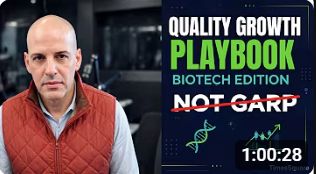
During their recent episode, Taylor, Carlisle, and David Ferreiro discussed When to Sell Growth Stocks: Valuation Targets and Portfolio Risk. Here's an excerpt from the episode:
[David]
Yeah, so that is an interesting anecdote on the book. And I could definitely make corollaries to our portfolio and definitely look over the last couple of years based on the type of manager we are. But in terms of the valuation question, cell discipline, I think that really embeds into once we've made the decision that a company is that belongs in our portfolio, we do structure important price targets around it.
We do that for a few different reasons. We have upside and downside targets and also our base case price target. We invest based on our base case price target.
We're usually looking for a certain return and that return. There's also a qualitative factor, which is risk in the position. So obviously, if we say we're looking for, say, 15, 20 percent return in a normal stock, if we're investing in a small biotech company, the risk, the return has to be higher because the risk is a lot higher.
So when we set the price targets, we want to have a certain amount of return that we can get. But then the upside and downside price targets are there for a few reasons. The downside price target is a pretty good predictor of we found.
And this isn't a study that we've done, but I think you can look and see the evidence that when the downside price targets breach, there's probably something wrong with our initial thesis, like something has gone horribly wrong. That's very easy to see when you're investing in a biotech stock, when they fail a clinical trial and that was a major value driver. You know, you don't have to be a genius to understand something went wrong there.
But with other businesses, like maybe it's a consumer business or financials business, the downside price target is very, very descriptive and usually an indication that something went wrong. But we also set the upside targets when things are going absolutely right. So it gives us that flexibility on valuation to, OK, they've met our primary price target.
This might be a sell signal or a sell signal really to take profit. But we might be in a situation where things are going as right as we would have expected them to go, which would give us some room to our upside price target. So in terms of sell discipline, we are pretty valuation conscious from we do pay attention to our price targets.
If we see big moves in a stock and our price objectives are met, if we think there's too much euphoria in the stock and really shouldn't be in the upside, then that really is what guides our sell discipline. And I'd say that we're pretty good at that.
[Tobias]
And what do you revert to? Do you sell down into cash or do you just have a roster of the next name up?
[David]
Yeah, I mean, it could go it can go either way. We will aggressively trim positions. You know, if we think there's still some room or we think there might be, you know, that the upside, that upside scenario is more likely than not, then those are instances where we're not going to sell the cash.
We're going to hold on to some of the position, but take some off the table now, because we've seen, you know, pretty dramatic move in the stock. And yeah, I think, you know, one of the lifebloods for any portfolio manager or any portfolio is just a constant flow of ideas. And that's why we have a team that are constantly looking for new ideas, myself included, to really rotate, to rotate fresh ideas into the portfolio, to make sure that we're not holding on to things or staying, you know, staying in something too long or staying in something just to tie up capital, which is always a recipe for disaster.
[Jake]
Why is it so expensive to get through clinical trials? I've read somewhere it was like a hundred million dollars or something. Maybe that number is stale now and it's even more.
But what's going on there?
[David]
Well, there's a lot of costs that get rolled into a clinical trial. Having never run one, I can't tell you exactly what it is, but I can tell you that the CROs, the contract research organisations are pretty good at laying all this out. And you could talk to the biotech companies about what it costs to run these things.
But there are a lot of reasons for this. And some of the reasons are you have to set up sites and monitor these patients on a pretty aggressive basis. So obviously all the blood tests, scans, et cetera, that you have to do on a regular, with regular frequency costs a decent amount of money.
And that could be, you know, tens of thousands of dollars per patient per year. And imagine that a trial, like I just mentioned, an Alzheimer's trial, if it has to last three plus years, or you're talking about a cardiovascular outcomes trial where they can last more than three years as well. And you can have thousands of study and you're talking about 10,000 plus a patient per year.
The cost of running those trials gets pretty high. You're outsourcing, you're running at a lot of different sites. Obviously, like you can't run a clinical trial at just one hospital.
You have to run it at multiple hospitals. In a lot of instances, when you're running in a lot of these harder to find indications, you're running in multiple countries globally. So that adds to the logistical complexity.
There's the cost of manufacturing the drug of which you have no offset, right? You know, you just, it's pure costs. So each, the cost of the drug, you know, is a portion of that clinical trial expenditure.
So it's a lot of that gets rolled into it. But I think a lot of it is making sure that when the trial is complete, that you have a full auditable set of data. And that's just not cheap.
The only way to bring down, you know, maybe this is part of the promise of AI, like I mentioned, one of the things that you can help with down the line is if you are accurately selecting patient populations, you're really sure that you are selecting the appropriate patient population for the drug that you're testing. You can start to reduce the sample size because statistically, you're hoping for a much cleaner outcome. And with that, cost should come in.
 Biotech Investing Risks: Why Clinical Trials Create Opportunities
 Where Is the Deep Value in Canadian Stocks This Week?
 AI Stock Market Bubble: Could Nvidia and Micron Face a Semiconductor Crash?