Biotech Investing Risks: Why Clinical Trials Create Opportunities
Tuesday, November 17, 2026
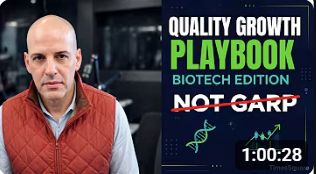
During their recent episode, Taylor, Carlisle, and David Ferreiro discussed Biotech Investing Risks: Why Clinical Trials Create Opportunities. Here's an excerpt from the episode:
[David]
Yeah. I think there's a couple of things with a name like Mirim. One, with the indications that they're in, like these small rare disease indications, I think there's always an element of upside for how big there could be an element of upside for how big the patient population is.
And in, in their case, the, the rare disease commercial franchise that they have right now was probably under-invested from the company, they, they, the companies that they acquired it from. So they were able to really streamline the, the sales process, identify patients, get their drugs out to doctors. So I think that's one element where you could produce some outsized return.
That's not, that's not always going to work because eventually the market does catch on and sees that you're able to identify patients. And, you know, that, that works for maybe a couple of quarters. But I think another place where, where there always is a level of, of, of unknown is just anything tied to clinical development.
I think that is like one area where there is true idiosyncratic risk in the market. Biology is inherently unpredictable and you really don't know what's going, what's going to work. So I think that adds like, you know, a real opportunity for you to take educated risks on things.
And, and a company like, like this is not always going to have that risk or have the upside fully baked in. So there's always going to be some level of upside, unless it's something that is truly easy to call. And those are the instances where you see a trial readout and the stock doesn't do anything or it's positive and it goes down.
Well, those, those are obvious that everybody knows. But I think a lot of times with, with these rare indications where there isn't a lot of precedent data before that, it makes it a little harder to predict that you get paid for taking that kind of risk. So I don't know if that fully answered your question.
[Jake]
Yeah. I think it's just maybe the people don't like to hold uncertainty and therefore things can get mispriced. Like the, the odds on offer if we invert from the price backwards of what the business could turn into.
That, that level of ambiguity could scare people off of it.
[David]
Yeah. Yeah. And there's, there's always like nothing is, nothing is perfect.
You know, there's always an element of regulatory risk as well. And there's commercial risk after that. So you're, you know, the, the earlier stage, the asset or the earlier stage, the thing you're gambling on, you have the, the risk of the clinical trial, the risk of getting the drug approved, the risk of actually executing commercially.
And those things compound, right?
 Quality Growth Investing: How to Identify Great Small-Cap Stocks
 Small and Micro Cap Stocks: Where Deep Value Meets Cash Flow
 AI Investing Lessons: Why Revolutionary Technologies Can Still Be Bad Investments