
Stock Market Valuations: Why Credit Spreads Could Signal the Next Correction
Thursday, November 5, 2026

During their recent episode, Tobias Carlisle and Tim Melvin discussed Stock Market Valuations: Why Credit Spreads Could Signal the Next Correction. Here's an excerpt from the episode:
[Tim] Oh, I try not to. When you look at the market, the valuations are ridiculous. I mean, you and I have had this conversation repeatedly, and that’s the problem.
We probably had this conversation three years ago, where the prices are ridiculous and they’ve only really gotten more so. And earnings growth is fabulous. And we’re looking for 27% earnings growth in the S&P 500.
The problem is like two-thirds of that growth is coming from just 10 companies. And 36% of the growth comes from two companies, Micron and Nvidia. So it’s very bifurcated.
It’s not as exciting as you get down the stack, but eventually there’s going to be a correction. And I see your book kind of thing behind you there, crash test dummy. I don’t know if it’s going to crash, but I will say this.
The reason it wasn’t going to crash is credit spreads were mega tight. I mean, credit spreads were tight. Financial conditions were very accommodating.
Now, there’s some changes in credit spreads lately, and we’ve finally seen how your credit spreads, the direction’s changed. It’s not gone. It’s now back over the low end of the normal range.
It’s not to the area where I would officially say it’s time to be cautious, but getting close. And when I look inside the credit market, I see that credit spreads in general are about a 3.4, 340 basis point spread. And by the way, this is, and I stole this a hundred percent, the math from Dan Rasmussen at Verdad, and it works and it tests extremely well.
Your best market indicators actually are your credit spreads. But when we look at double B credits, you ready for this? A double B credit right now is only at about a 260 spread.
It’s very tight. A B is right in line with the market at a 346. We are now at 1,375 basis points in triple C and under.
Current coupon triple C yields are 18%.
[Tobias] Okay.
[Tim] So that’s, we’re seeing much like in the consumer market, the low end is suffering. And five years ago, they could have issued triple C paper at eight and three quarters, eight and a half, maybe nine if they had really stinky credit. You’re not refinancing that today at that rate.
You’re refinancing closer to that 18. So there’s some damage coming in at the lower end. Not a big deal.
If you’re a bank, not really a big deal. If you’re owning most of the high yield market, big deal. If you’re a company that goes out of business that you default and you go into receivership and now people are getting laid off and executives are being let go.
Mortgages aren’t getting paid. Car payments aren’t being made. They’re not going to the local grocery and downsizing right from brand names into generic.
So that begins to have an impact on the communities where these companies are. And if that begins to creep its way up, then you’re going to get mission creeping credit spreads and you start to see the cracks in the system that will eventually take us from these nosebleed valuations down to reality. You and I have both been doing this a long time.
Valuations always reset to reality. They also always take a lot longer to do so than you would think is possible. But we saw it with the internet.
And if you think about the internet in 99, the story was that these things have to keep going up. Internet’s going to change the world. It’s going to make us all more productive.
It’s going to make companies more profitable. It’s going to change our social lives. It’s going to change the very fabric of society.
It’s going to become essential. And you know what? Every single bit of that happened.
You bought those stocks in 1999. You got beat. Oh, my goodness, did you get beat.
You got beat worse than the Tampa Bay Rays got beat last night. I mean, it was just horrible. And, you know, the greatest company in the world, Microsoft, took 17 years to break even.
Someday, investors in Cisco are hoping they will break even. It’s still not happened. And a lot of the companies just disappear face of the earth.
Is that going to happen here? Yeah, probably. I mean, when I look at the implied rates of return in the hyperscaler spend, that’s going to be tough because these returns could very well go back to utility like rate of return, particularly in data centre projects.
And it’s going to change our life. It’s going to make the world better. It’s going to make everybody more productive.
It’s going to do things that we never dreamed of with the internet. Artificial intelligence, in my mind, is as big as electricity. I mean, I think the impact can be like that.
It doesn’t mean these companies are worth this, especially the second and third tier players. So at some point, the market will correct. It’s probably not today, but most of my stuff is not in the mainstream market.
And even my more mainstream companies that I own tend to be in Hong Kong or France or somewhere besides the U.S., not because I’m a macro expert, because the list got too short.
 Undervalued Private Credit Investing: Finding Value in Discounted Lending Funds
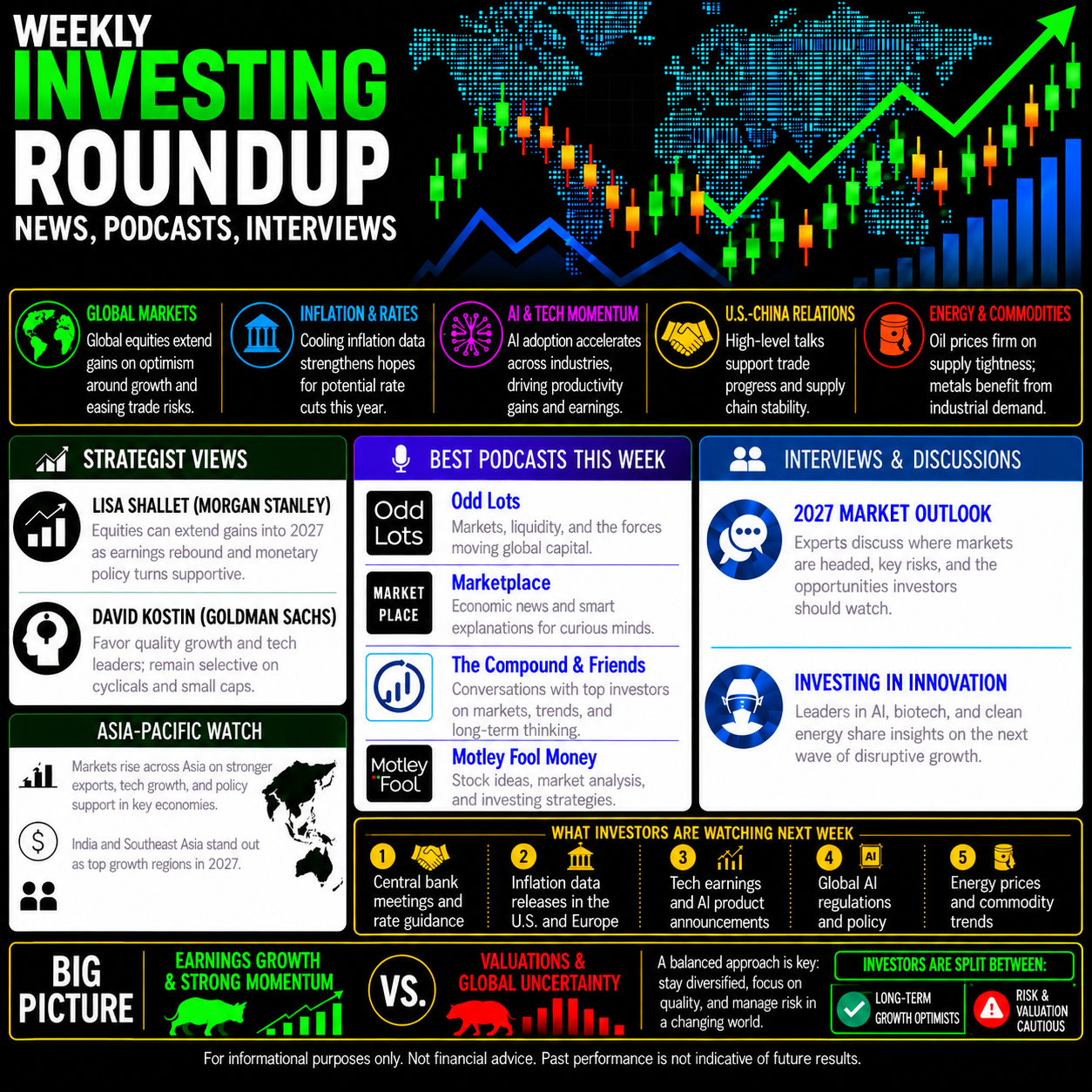 Weekly Investing Roundup – News, Podcasts, Interviews (11/06/2026)
 Netflix Stock Valuation: Is Netflix Undervalued Compared to YouTube?