
Where Is the Deep Value in Small and Micro Caps This Week?
Tuesday, November 3, 2026

The Acquirer’s Multiple® Small and Micro Cap screen searches a less heavily followed part of the market, where limited analyst coverage and lower institutional ownership can sometimes allow significant valuation gaps to develop.
This week’s supplied screen contains 217 companies, with a median Acquirer’s Multiple of approximately 7.3x. Of those, 132 trade below 8x and 53 trade below 5x.
The latest export contains more companies and a greater concentration of low-multiple businesses than last week's supplied screen. Differences in the underlying coverage mean these changes should not necessarily be interpreted as a broad decline in market valuations.
The cheaper end of the screen continues to include businesses across financial services, technology, energy, healthcare and consumer-related industries, providing investors with a range of potential opportunities to investigate.
Where the Cheapest Opportunities Are Concentrated
The sub-8x group spans several areas of the market, including:
Banks, investment services, specialty finance and insurance
Software, internet and data services
Energy exploration, downstream energy and oilfield services
Mining, metals and commodity-related businesses
Apparel, automotive parts and consumer-related businesses
Healthcare, medical devices and biopharmaceutical companies
Food and beverage production and industrial manufacturing
Transportation, telecommunications and infrastructure services
Financial businesses are particularly prominent, with banks, investment services, specialty finance and insurance accounting for 60 of the 132 companies trading below 8x.
Banks represent the largest individual industry group, with 39 companies, while insurance and investment services contribute another 17 combined.
This concentration highlights the substantial representation of financial businesses among statistically inexpensive smaller companies. However, investors should consider that traditional enterprise-value and cash-flow measures can behave differently for financial institutions, making industry-specific analysis particularly important.
Technology remains another important source of potential opportunities, with qualifying businesses across software, internet and data services, electronic components and technology consulting.
Software and internet and data services each contribute seven companies to the sub-8x group.
These businesses operate across different markets and business models, from recurring software revenue to digital infrastructure and technology services.
While low valuations may reflect concerns about slowing growth, competitive pressures or changing technology spending, businesses with durable customer relationships and consistent cash generation may warrant further investigation.
Materials and mining also feature prominently, with companies involved in metal ore mining and commodity-related production.
Several businesses trade at relatively low multiples of operating earnings, reflecting the cyclical nature of commodity markets and the potential for significant changes in profitability as prices fluctuate.
Investors should consider whether current earnings reflect sustainable operating performance or temporarily favourable commodity conditions.
Energy businesses remain represented across exploration and production, downstream operations and oilfield services.
The group includes companies exposed to different parts of the energy value chain, with earnings influenced by commodity prices, refining margins, production costs and capital expenditure cycles.
Low valuations can provide a starting point for further research, although investors should assess balance-sheet strength, reserve economics and the sustainability of free cash flow through different industry conditions.
Healthcare continues to contribute a diverse selection of statistically inexpensive businesses, including biopharmaceutical companies, diagnostics providers, medical devices and patient care services.
These businesses can have very different earnings profiles, ranging from established healthcare operations to companies dependent on product development, regulatory approvals or specialised treatments.
The sector's inclusion reinforces the importance of understanding individual business models rather than relying exclusively on headline valuation multiples.
Consumer-related businesses also feature across apparel, automotive components, food and beverage production, retail and household products.
These companies face different economic pressures, including consumer spending, inventory management, input costs and competition.
Some may benefit from established brands and recurring customer demand, while others are more exposed to cyclical changes in discretionary spending.
Transportation, infrastructure services and industrial businesses provide further diversity among the cheaper companies.
Overall, the sub-8x group remains spread across multiple industries, although financial businesses account for a particularly large share of the qualifying universe.
Cheap—But Are They Producing Cash?
A low valuation becomes more interesting when it is supported by cash generation.
Among the 132 companies trading below 8x, the median free-cash-flow yield is approximately 11.6%, and 122 report a positive free-cash-flow yield.
The group’s median five-year return on assets is approximately 9.6%, while 111 companies report a positive shareholder yield.
These figures suggest that many of the statistically cheap companies are also generating cash and reporting positive shareholder returns.
The median free-cash-flow yield remains in double digits, although it is lower than the approximately 13.8% reported in last week's sub-8x group.
The median five-year return on assets has also moderated, from approximately 10.6% to 9.6%.
However, the latest supplied screen contains a larger number of companies trading below 8x, making direct comparisons sensitive to changes in the underlying universe.
The proportion of sub-8x companies reporting positive free-cash-flow yields is approximately 92%, while around 84% report positive shareholder yields.
These measures suggest that a substantial proportion of the cheaper companies have characteristics worth investigating beyond their headline valuation multiples.
Nevertheless, high free-cash-flow yields can sometimes reflect temporarily elevated earnings, cyclical conditions, unusually low share prices or market concerns about future profitability.
Positive shareholder yields also require closer examination, particularly where dividends or repurchases may not be sustainable through weaker economic conditions.
The combination of low valuations, positive cash generation and historical profitability provides a useful starting point, but further research is needed to distinguish durable opportunities from potential value traps.
Why Small and Micro Caps Require Additional Research
Smaller companies can offer greater valuation discrepancies, but they can also have lower trading liquidity, more volatile earnings, concentrated customer bases and less comprehensive public information.
These characteristics can create opportunities for investors willing to undertake detailed research, but they can also increase the risks associated with individual investments.
Financial companies require particular attention because traditional measures of debt, cash flow and enterprise value can behave differently from those of non-financial businesses.
This is especially relevant given that financial businesses account for approximately 45% of the companies trading below 8x in this week's supplied screen.
Investors should also consider the potential impact of limited trading liquidity, particularly among micro-cap companies where relatively small transactions can produce substantial price movements.
The Acquirer’s Multiple is a starting point for research. Investors should examine debt, cash-flow consistency, capital allocation, competitive positioning and whether recent earnings are unusually high.
The representation of financial, technology, energy, materials and healthcare businesses reinforces the importance of understanding industry-specific risks before interpreting low valuation multiples as evidence of undervaluation.
Bottom Line
Approximately 61% of this week’s 217 Small and Micro Cap companies trade below an 8x Acquirer’s Multiple, with 53 companies trading below 5x.
The sub-8x group has a median free-cash-flow yield of approximately 11.6%, while 122 of the 132 companies report a positive free-cash-flow yield.
With a median five-year return on assets of approximately 9.6% and 111 companies reporting positive shareholder yields, the cheaper end of the screen continues to offer a substantial pool of statistically inexpensive businesses for further research.
Compared with last week's supplied screen, the number of companies trading below 8x has increased from 82 to 132, while the number trading below 5x has risen from 40 to 53.
The overall median Acquirer’s Multiple has declined from approximately 9.1x to 7.3x.
However, the latest export contains 217 companies compared with 200 previously, and the difference in coverage limits the conclusions that can be drawn from these changes.
Among companies trading below 8x, the median free-cash-flow yield has declined from approximately 13.8% to 11.6%, while the median five-year return on assets has eased from 10.6% to 9.6%.
Despite these lower median figures, a substantial proportion of the cheaper companies continue to report positive free cash flow and positive shareholder yields.
Financial businesses dominate the cheapest end of the supplied screen, although potential opportunities extend across technology, materials, healthcare, energy and consumer-related industries.
The results demonstrate that low valuations remain available across a diverse selection of smaller businesses, but investors should assess earnings durability, financial strength, capital allocation and trading liquidity alongside headline valuation multiples.
The complete premium screen allows subscribers to identify the individual companies behind these statistics, compare their rankings and examine the underlying valuation, cash-flow, shareholder-yield and quality measures.
These measures provide a starting point rather than a conclusion about any company's investment merits.
In addition to our free U.S. Large-Cap 1000 Screener, subscribers receive access to the complete All Investable, Small and Micro Cap, and Canada All TSX screens—including company rankings and valuation, free-cash-flow, shareholder-yield and quality measures.
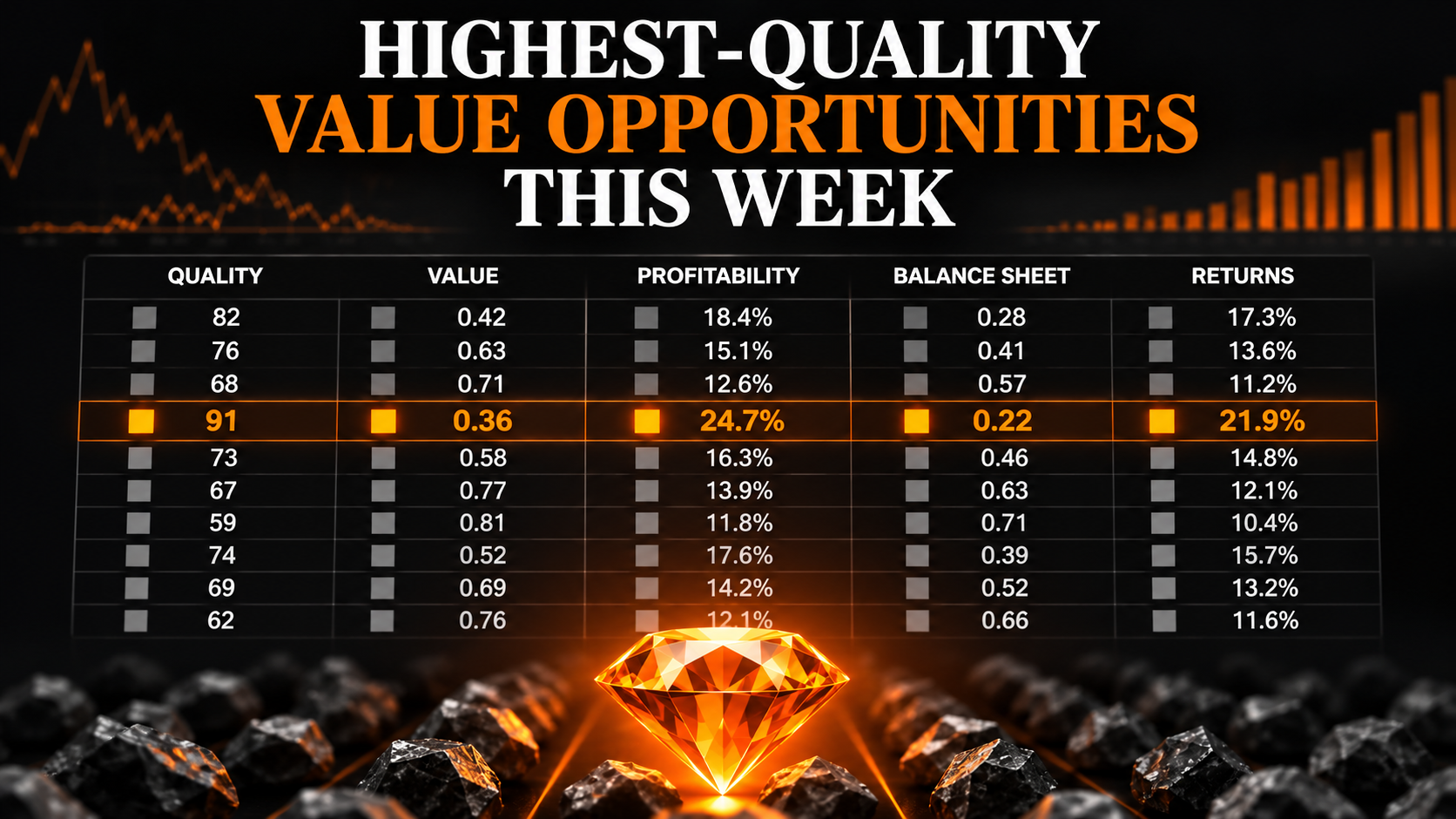 Where Are the Highest-Quality Value Opportunities This Week?
 AI Stock Market Bubble: Can the Technology Succeed While Stocks Crash?
 Closed-End Fund Investing: Buying Assets Below Net Asset Value