
VALUE: After Hours (S08 E36): Tim Melvin: Finding Value Where Wall Street Isn’t Looking
Sunday, November 1, 2026
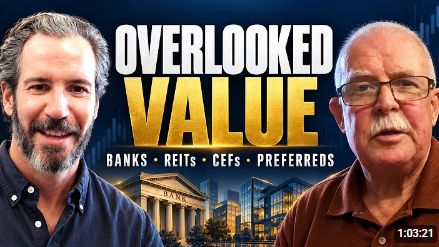
During their recent episode, Tobias Carlisle and Tim Melvin discussed:
Overlooked Opportunities in Small Banks
Undervalued REITs: Finding Opportunities in Commercial Real Estate
Closed-End Fund Investing: Buying Assets Below Net Asset Value
Private Credit Investing: Finding Value in Discounted Lending Funds
Stock Market Valuations: Why Credit Spreads Could Signal the Next Correction
TRANSCRIPT
[Tobias]
This is Value After Hours. I'm Tobias Carlisle. Jake is on a break today.
Special guest today is Tim Melvin. He's a returning guest. We've had him on quite a few times.
How are you, Tim? Good to see you again.
[Tim]
I am fantastic. I'm learning how to live with winter again, being in North Carolina after moving up here from Florida. And it's threatening to go below 70 today.
I may panic. I don't know.
[Tobias]
Rug up, wear something warm. You're in one of the more interesting, you look one of the more interesting areas of the economy. And I mean that in the Chinese curse sense of the word.
Financials, community banks, what's been happening there?
Overlooked Opportunities in Small Banks
[Tim]
Well, I mean, the headlines are awful, as you know. I mean, stable coins are going to make banks all just go away. All of the bond losses are going to collapse every bank that ever lived.
And so when you read the headlines, and they've been awful since really 2023, when we went through all of the Silvergate and- That was SVB, was it? Silicon Valley Bank. And yeah, all that.
And the banking crisis that wasn't is what I like to call it, because it was four bankers that did really stupid stuff and collapsed. And we decided that was an absolute banking crisis. And it wasn't.
Wish it would happen again, because it was this tremendous buying opportunity. But banks are starting to report, and as the earnings come in, and you're going through them, and once again, it's going to be, it's getting very repetitive, right? Credit's way better than anybody's giving these guys credit for.
Because the old joke is, bankers are somebody who won't make you a loan if you need one. That is exactly correct in this environment. If you really need a loan, you're probably not going to get it from a community bank.
They're not doing subprime. They're not doing near prime. You're prime, or you don't get so much as a credit card from the smaller banks these days.
So capital levels are high. Loan quality is pretty good. Couple little cracks.
But the thing to remember is the areas of credit where there is a problem, large commercial real estate, right? Especially class B and class C properties in major cities.
[Tobias]
Is that office?
[Tim]
What's that?
[Tobias]
Is that office or what is that?
[Tim]
That could be office. That could be multifamily. Just anything that's not brand new, right?
It is probably running into a problem. And when you look at CMBS, commercial mortgage-backed security delinquency rates, it shows up, right? The older vintages, there's problems.
Class A and trophy properties, not so much of a problem. But the community banks that I buy, they're not in that stuff. They don't do syndicated loans.
They're not doing second and third tier office buildings for the most part. Most of their stuff is, you know, Joe's Garage, Small Town Business Park, right? Fred's doctor's office.
They're the buildings that you drive by and you go into each and every day of your life. Those are the ones that they have. And frankly, there's no delinquencies.
Just, I mean, there's some, but you know, nothing that we're going to lose any sleep over. So at the bank level where I deal, and I deal with smaller banks. I mean, I keep getting asked, well, what do you think of JP Morgan?
I don't, truly. I read his annual report because I just, I always hope, and I'll check the conference call minutes because I'm always hoping that Diamond blows up. Because when he blows up, he's one of the best speakers on the planet, right?
When he has one of his Diamond meltdowns. But I don't really care what the bank does other than, you know, they're there. They're the big giant in the room, but you know, Bank of America, Wells Fargo, I don't read those reports anymore.
There's no need to. We're dealing with the smaller local banks. There's about 4,400 of them left down from 18,000 when consolidation started.
And we're going to a thousand or under, Toby. I mean, it's just, it's going to happen. So conditions in the industry are great.
When we look at the industry as a whole, my only complaint is getting tougher to find cheap banks.
[Tobias]
Right. Because it's moved up? They've all moved up.
[Tim]
They've moved up. I mean, it's, we send out a list about once a quarter of all the, what I call the nano cap banks. And these are small banks and they, you know, they trade a few hundred shares a day if you're lucky.
And I know some folks will, you know, and I've seen some of these reports and they're kind of, I get a kick out of them because they're, oh, we drove to the bank and we met, you know, Miss Ethel's cookies and, and we saw everything and we visited the town. And I don't do that because I've found very little value add to it over the years. And banking is a numbers game.
If I get the numbers right, this all comes to pass. But the average of these nano cap banks is up like 30% on the year. And it's just so where my, and I'm pretty strict on valuation on everything, as you know.
So I'm looking at banks. I want to buy them 80% of tangible book value with negligible, negligible loan losses and lots of capital. I can get the second to, I can't get the price to book value that I want to pay right now widely across the board because they have moved up so much over the past couple of years.
I'm, you know, I'm hoping somebody somewhere in the administration or in the industry will do something epically stupid and drive the prices down for me again. But I've learned that I have to be patient and wait for that to happen.
[Tobias]
Do they struggle with the yield curve when that's sort of inverted or, you know.
[Tim]
I mean, it depends on the bank. They can. I mean, you know, obviously if your deposits are bringing in less than the loans that you're putting out the door, you can have a pretty serious problem.
You can't do that. That's not good as a banker. Right.
But generally speaking, they're kind of hedging against it most of the time. A lot of them will just stop making the loans and park the money in securities as well. And that's one of the big advantages of being a smaller bank.
You can do that. Jamie Dimon absolutely cannot do that. There's not enough securities on the planet for him to just stuff all of his money into that.
[Tobias]
Isn't that what got Silicon Valley Bank into trouble?
[Tim]
Silicon Valley Bank, this is, first off, you know, Silicon Valley Bank, I fell across in the 90s when I was first starting to do banks in a big way. And we bought it and tripled our money and sold it a few years later and thought we were geniuses. Right.
And it continued to go from my sales price up by a factor of 10. At one time, this was one of the best run banks in the country. Right.
But they got stupid. And what they did was epically stupid. And how the regulators did not pick up on this is one of those stories that need to be talked about.
Right. And it was talked about a little bit in a recent report. They took in large deposits well above the FDIC limit.
Right. So these are people that are going to worry when things happen. And then they did, you know, all venture capital backed companies, venture capital executives.
So they've already got all of this uninsured deposit money. Right. And it was like 90 percent of the deposits.
It was huge. But then they made probably the biggest mistake you can make in banking or investing, and they believed the Fed. The Fed in early 2022, late 2022, early 2023, was telling people, we're not going to raise rates for years.
Right. It'll be 2024, 2025 before we even have this conversation. Now, let's go ahead and switch and open the economy back up because it's all going to be great.
And it was great, but we broke the supply chains and we had wild inflation. And all of a sudden rates start going up. These guys have loaded the boat on 2 percent mortgage backed securities on, you know, two and even one and three quarter percent treasuries with 30 years to maturity.
Right. So they're long duration, low yield, and there's nowhere to go. So they can't get out.
They can't afford to take the loss. They basically wrecked the bank in the course of a week. Well, it didn't help that.
You see, in the old days, when this happened on that Friday, right, and everybody's starting to panic and the VC funds were calling their clients and saying, you really need to get your money out of that bank. We think it's going to go under and you're way over the insurance limits. In the old days, we couldn't have got the money out till Monday morning.
By Monday morning, they'd semi fixed the problem.
[Tobias]
Right.
[Tim]
However, this guy right here, there's stories that I talked to some folks, they were on a bus going from the airport to a conference in Reno on Fintech. And they got that and just the whole bus is just sitting here. They're doing this and they're moving their funds out of the bank.
So just there was like nobody smart involved in this bank at the end, apparently, because they made every mistake you can make. From my point of view, I love them for it and I want to thank them publicly, because you set off this thing where people were dumping out the big banks.
[Tobias]
Well, there's never one cockroach in the kitchen, right? That's the theory. You see that one cockroach and then you just imagine that's in- There were four.
[Tim]
There were four cockroaches.
[Tobias]
Four cockroaches.
[Tim]
And it's a good theory, but until you looked at what was actually happening, it wasn't a credit deal. It wasn't that loans were going bad all over the country like we saw in 2008, 2009. It was four isolated incidents tied to a specific corner of the industry, setting up some very cool conspiracy theories about how the bankers just wanted to kill off the crypto guys and all that.
But literally, you just- And I know I did it and I know a bunch of other people did it, just calling bankers. Are you worried? And the answers went from not really to about what?
I'm sorry, did I miss something? Because it wasn't happening, right? Nobody was walking in to the Peoria Bank and Trust and saying, give me all my money.
And that one, you know, nobody went into Coleman Bank down in Alabama and said, hey, I'm really scared. Give me all my cash. I'm taking it out.
So it happened nowhere except in those four banks.
[Tobias]
Do you have any good names? Do you have any representative names in the community bank space that sort of interesting at these levels?
[Tim]
Okay, here's representative of the type of bank that I absolutely love to buy. Now, this is a recent thrift conversion. And a thrift conversion is- Wow, that thing's up big last week.
I should pay more attention- is when a mutual thrift converts to a publicly traded bank. And they do it for a tonne of reasons, but mostly it's because they want to be able to get out of just doing mortgage lending and owning securities and maybe get into commercial real estate. Quite often, it's a liquidity event.
They're looking for a door. So one of our most recent purchases was Hoyne Bank Corp. And this is a thrift conversion out of Illinois, the symbols H-Y-N-E.
We were buying it. Let me just get the exact price up here on the screen. We were buying this thing probably at 75 to 77% of tangible book value, not too terribly long ago.
It's trading at 84% of tangible book value right now. You can still buy it. But the equity to assets measure is just exactly what it sounds like, right?
You divide the total equity by the assets. And the higher it is, the better. The minimum is somewhere around 6% that you have to have to be properly capitalised.
These guys are at 34. They may be the largest in the industry. And it's just a little bank.
It's in Illinois. The executives are older. I would not be surprised if this wasn't looking for an exit, which is quite often the other reason that you do a thrift conversion.
They have no loan losses to speak of. They're very negligible. It's a heavy residential lending portfolio.
And they do own a lot of security. So they're going to take some marks in here. And it may hit book value a little bit.
And I truly do not care because we're at 34% equity to asset ratio. At the end of it all, when they drop the big one on us, it's going to be Keith Richards sitting on the stairs of this bank talking to a cockroach and smoking a cigarette because they're going to be the only things left, right? I mean, this bank's got too much capital to kill.
So we're comfortable buying it. Now, there's a change of control. The control cannot change here for a couple of years because there's a three-year change of control when you buy a bank, when you do a conversion, I'm sorry.
But I'm willing to sit and own it because they just buy back a lot of stock and push the stock value up, which they can start buying back stock next year, a year from the conversion. And most of them do buy back an enormous amount of stock. Once that starts happening, the stock price begins to go up.
So that's really representative of what we love to do.
[Tobias]
What price do you normally, you said that's at 84% tangible book value. What do you normally like, like a grey MITE 66 or where do you like to?
[Tim]
Well, you're not going to get 66 without fleas and it won't pay for it. The point, you don't want fleas or dirt in the banking system. I've learned that one painfully, um, where people will say, well, I'm willing to take a chance.
This bank's got an equity assets of eight. Good luck. I'm not right.
Or, you know, the loan, the non-performing assets is a little high, but I think they're going to fix it. Cool. I'll wait, you know, and when they start to fix it, um, I'll get interested again.
Um, but generally if I can get this thing in initial position around 80 or less, I'm pretty happy. Um, and we've just, we just buy a whole bunch of those. I mean, in a really good market, I can own 60 of these things.
Right. And you know, my newsletter will be about this long because of the, just the buy list. We're not at that right now.
I mean, I think we're probably down to about 15 banks at the moment where we can jump up and down and scream and yell and say, you can buy these. There's a few more nano caps than that. We send out the list of the nano caps.
I do not publicise them. I don't talk about them. That's how you get to meet the people from the SEC and the NASD because they do trade by appointment, but this is wildly successful.
All right. The rate of return here in real terms, I think is higher than most mutual funds or hedge funds even think about turning in and we don't use leverage. I mean, um, what's the downside?
You're not trading these, right? If you think you're going to need the money, you can't buy these. Most of them, right?
Um, you're buying, you're not trading a stock, you're buying a bank and you have to have that mindset, but the returns are pretty good. And if you hit, if you go boom, boom, boom, and you check all three boxes, right? You're just not taking a lot of financial risk.
I can't do anything about price risk, except use it as an opportunity that I can avoid financial risk like a plague.
[Tobias]
Um, what about rates? What's happening in, uh, what's happening in rates?
Undervalued REITs: Finding Opportunities in Commercial Real Estate
[Tim]
Well, again, apparently nobody's ever going to an office again.
[Tobias]
Yeah.
[Tim]
And I'm guessing we're all going to live in tents. I'm because, uh, multifamily, everybody is a very negative on multifamily housing. And I don't understand how you can be right now because banks aren't doing any new loans.
So supply is starting to ease up and we didn't have a supply wave, but that's easy. Most people can't afford a house, right? So the old cycle of we're going to graduate, we're going to meet the spouse.
We're going to have a first child. We're going to live in an apartment while that's happening. And then eventually we'll move out of the apartment.
Well, there's a whole generation now that's stuck in front of the generation graduating. Now they can't go anywhere, right? So there's tonnes of demands for multifamily apartments.
And when I look at commercial real estate and this has been the case, right? Reads are now cheaper than the actual real estate. So you've got a disconnect in valuation because public money runs scared.
And we've seen what happened with office thanks to COVID. Um, so everybody assumes all offices are done, but then, uh, it was Jay Hadfield and infrastructure cap infrastructure capital went around and visited all of the office buildings in New York that were owned by the REITs that he was looking at. And what he found was, is that the bigger buildings, the newer buildings, the nicer buildings, they're full, right?
They're running at normal occupancy rates. And these are the properties usually that REITs own. So the only weak spot out there I see is offices.
When I look at warehouses, they're full. When I look at apartments, occupancy rates are pretty high. When I look at, um, hotels, I mean, the recovery is kind of there.
Nobody's staying home and avoiding, especially leisure travel because of COVID anymore. That's not a thing that's over. So they're starting to catch back up.
And the two largest casino REITs in the country, extremely well-financed, very low debt ratios, uh, very high interest coverage ratios are now trading at, uh, about 80% of our internal, um, net asset value numbers. And that's Vici properties, which is just this stunning collection of real estate.
[Tobias]
That's the Las Vegas, uh, casinos, right?
[Tim]
Tonne of Las Vegas casinos, but they do have, they've diversified, right? They've got some other properties around the country off the strip, but they do, they own a large block of the strip. And they also have four golf courses in and around Vegas.
And they actually have 40 acres adjacent to the strip. That's just sitting there as raw land that they haven't done anything with. So for this thing to be trading at this price with this yield, uh, which is, I think it's 8% now is just ridiculous.
I mean, it makes absolutely no sense because they didn't miss a rent payment during COVID. They didn't miss any rent payments back during the, um, great financial crisis, right? People love to gamble and I know you could do it on your phone and you could do it here, but there's a certain allure in the American psyche for Las Vegas.
And now you add in Vegas has added all these sporting teams and sporting attractions. So it's even more of a tourist destination now.
[Tobias]
So there's been some suggestion that Vegas has had this little bit of a slump recently because it's too expensive. What do you think?
[Tim]
There's a little bit. And when we look at this, we have a bifurcated economy. Everybody knows the K shaped economy, right?
Well, the bottom leg of the case, get a little larger and you know, the bottom 50% of Americans, inflation, energy prices, all of this is starting to hit them. The affordability of housing, you know, look, I try to avoid it, but occasionally I have to go to the grocery store. Um, and prices are going up and they're going up consistently, not as dramatically as they were, but stuff still costs more and energy has come down a little bit, but it's been running consistently much higher.
And so that all, it takes a bite and that eventually takes a bite out of some of Las Vegas travel. And yeah, it's expensive to go to Vegas, but the casino business, as long as they have the whales, everything else is just extra cashflow.
[Tobias]
And it's a cyclical business when it's when you want to buy it.
[Tim]
Yeah. Yeah. I mean, it's, it's, it's going to come back and this real estate is all a very long-term leases 20 years and more with accelerator clauses in the lease.
So there's kind of a natural dividend growth built into these things. So when you look at VG, which is VICI and a gaming and leisure properties, which is GLPI, I mean, GLPI. Yes.
[Tobias]
What a, what a missed opportunity for those should have been selling those weight loss drugs.
[Tim]
Yes. So, you know, we like both of those. Um, Cousins property, CUZ is a Sunbelt office street and it's got to, this thing should be trading at a massive premium to net asset value.
It is not, it is trading at a discount to net asset value, very well financed. And these aren't just classic buildings, right? First they're in the cities.
Everybody's moving to Charlotte, Tampa, Orlando, Atlanta. There were everybody's moving from the Northwestern Northeastern cities in the Midwest. These aren't the class A buildings.
They're the trophy buildings. They're actually getting a premium to class A office space and rent. They're the very best buildings with the very best amenities and they charge for it and they're full.
So this thing sitting here trading, it's about a four and a half percent dividend. So this isn't your, you know, this isn't the one to invest in if you absolutely need the maximum cash, but it's just sitting there just spitting out cash. It's undervalued and it's, you know, at some point that value begins to get recognised in the marketplace.
And it's offices and that brush paints wide, but the truth is there's still a lot of people going to work every day. Not in Greensboro, thankfully, we never had rush hour, but I'd rather imagine that in Atlanta, traffic hadn't gotten any better because somebody or same with LA or anywhere else. But this is all mostly Southeastern Sunbelt, a little bit of Austin.
The buildings are full and they're charging top dollars. So when we look at that, it's hard not to get excited about that. We like the retail space too, especially the standalone retail space like ADC, which has seen very heavy insider buying.
And that's a GE realty company. And that's just, that's Starbucks, that's the Home Depot, that's standalone properties. It's yielding about 4.79%. It's gas stations. We've got decent amount of insider buying pretty much continuously since the end of last year. And it's just, you know, long-term standalone buildings, triple net lease properties, which means that the tenant is paying maintenance, they're paying insurance, they're paying taxes. All the REIT is doing is taking the money and cashing the check.
So to me, that's a pretty good deal. And like I said, most of these tend to be essential businesses that never closed during COVID. They're not franchises that are going out of business for the most part.
So we're real comfortable owning that because again, very well-financed, very little actual financial risk and buying it at a discount to net asset value. And then the other one that we like is CTO Realty. This is the old CTO Consolidated Samocha, which at all value investors will instantly recognise the name because everybody owned it back in the day, right?
It was this collection of real estate. And then a few years ago, they did the real REIT conversion. And this one's thrown off a huge dividend income.
And it is open-air shopping centres for the most part in areas with high property density and high average incomes. And you've got about a 7.7% yield trading at around 80% of our internal estimate of net asset value. Very low multiples of funds from operations.
So the dividends are covered and growing. They are going to disappoint earnings today because I talked about it on the show today on the 27th of October when we're actually filming this. So they're reporting earnings after the market and they're probably going to disappoint.
So I think you're probably going to get a better price tomorrow because that's always how this happens for me.
[Tobias]
You think they're going to disappoint or are they going to disappoint because you're talking about it today?
[Tim]
No, they're disappointed because I'm talking about it. I've got a friend that he figured out that the secret to getting rich in life was to ask me what stocks I liked and wait three months.
[Tobias]
Too early.
[Tim]
Now, they also own a big chunk of another REIT that does triple nets, and that's Alpine Realty. It's a smaller one, PINE. It desperately needs to be sold to one of the bigger ones.
And I think at some point it'll happen. In the meantime, it's trading, again, about 80% of our estimate of net asset value and throwing off a lot of cash. So either the world's going to end, we're all going to live in tents, nobody's ever going to work again, nobody's going to travel or stay in a hotel, we're all going to use Airbnbs and pay the extra cleaning fee, or real estate is ridiculously underpriced from a long-term investor's point of view.
[Tobias]
Good one. Closed-end funds. What do you think of closing closed-end funds?
Closed-End Fund Investing: Buying Assets Below Net Asset Value
[Tim]
I love closed-end funds. We started buying closed-end funds in the 90s in the aftermath of Drexel Burnham, because I worked for Dean Witter. And Dean Witter back then, they loved closed-end funds.
Closed-end funds, you could pitch them as IPOs, because closed-end funds are not like normal mutual funds. When you buy a fund from Fidelity, you're transacting with the fund, you buy and sell through the fund. In a closed-end fund, there's an IPO, and then it trades on the exchange, just like a regular stock or bond.
So Dean Witter loved them, because you could pitch those and there was no direct commission, 7% sales charge, mind you, built in internally, but no obvious commissions. And they did a lot of junk bond funds. So when Drexel blew up, so did the funds.
So the funds were sitting here and they had all these milk and underwritten junk bonds in them, and a bunch of first Boston stuff. But most of the loans were still performing. A lot of them were going to go out, but probably 75% of the market never defaulted.
So we're getting 15% yields and paying a 20% discount on these closed-end funds. It was the no-brainer of the day and it worked out tremendously well. And we've seen dislocations like that, that occur in markets and it creates opportunity in closed-end funds.
Now, there's a natural opportunity to a closed-end fund that I've always found attractive. Again, Fidelity, BlackRock, all of the major mutual fund companies, they advertise constantly on the financial networks, online, everywhere you look, there's ads and advertising for this fund and that fund and this fund. There's no marketing for closed-end funds.
There's no natural aftermarket buyer because it trades on the exchange. So you can't trade, you can fix your NAV every night. You know what it is, but you can't change the market price.
You can't fix that. So you become subject to the same psychological soup of the stock market that everybody else is. So when it's popular, your fund will actually trade at a premium, more than the actual value of the stocks and bonds owned by the fund.
Most of the time you'll trade at a small discount. Occasionally, you'll trade in an above-average discount. That's when it starts to get interesting because now we can step in and we can be buyers of these funds at a discount.
Over time, nature will eventually, market cycle will change and buyers will come in and then capital narrow by itself. I'm greedier than that. I want the discount.
I want the nice yield and I want an activist. And there's a couple of them in the space. For years, the biggest player was Bulldog Investors.
That was Philip Goldstein. And Goldstein had a great backstory, had a partner that was an ex-Dean Whitter broker like myself. And so that was it.
But he was an engineer for the city of New York, worked on bridges and stuff around the city of New York. But his natural attraction to math bought him the closed end funds and he ended up running a successful hedge fund where they would buy these things at a discount. And then they'd go in and they'd go to the fund and say, look, we own a lot of your stock.
Classic activism, right? You need to do something to make this discount go away or we will launch a proxy fight. So what can the fund do?
Well, they can liquidate and give us back the cash. They don't like to do that. Closed end funds are captive capital, right?
They're permanent capital is the phrase that they like to use on Wall Street. Capital leaves a regular mutual fund. You don't get fees on it anymore.
You raise a fixed amount in a closed end fund, you get fees on it forever. So they're not going to liquidate it. They don't want to do that.
So you can buy back stock. You can conduct a tender offer, which is the norm. We see a lot of those.
We just saw a couple of those in the industry. So generally speaking, we're looking at a couple of ways of making money. One, the asset class turns around.
Like right now, if you're buying into certain segments of the bond market and they lower rates in a couple of years, the asset class is going to turn around. B, the discount narrows or even goes to a premium. That's driving the price up.
And then C, you're collecting a dividend yield.
[Tobias]
Do you follow that activist, I forget his name, but his Saba Partners?
[Tim]
Oh, Boaz Weinstein. He's the 800 pound gorilla. I was going to talk about him.
He's the biggest player in space right now. And he lost a couple of cases with the courts as far as what he can and can't do to force closing or to force the closing in NAV. But he's still a powerhouse and he's still in there.
Is he active in the UK? He's doing a lot in the UK now and he's getting, you know, he just lost a big one with, oh, I forget who it was. I have to go.
Oh, the growth fund people. I think of it. But he just lost one there, but he didn't go away.
He just kept going. So I'm trying to force them to do something. And he's going to be successful more often than not eventually, because if you're determined enough, once you get over 50%, you can just replace the management of the fund.
And there's more and more people kind of playing in this space. So, you know, in the old days, when Goldstein was doing it, he was by himself and he'd be calling individual shareholders trying to get their vote. Now there's enough of an institutional block, particularly in the United States, that you can represent a fairly large front when you go in to make the demands.
So, but yeah, they are playing more and more in the UK. We are interested in the UK market because those discounts are huge. They've always been huge.
You see some of the biggest hedge funds in the world. Pershing Square was always the example. They trade on those London exchanges.
Their fund markets are different than ours. So it is interesting to us and we're kind of tracking and starting to follow what he's doing there. And once he starts having a little bit more success in forcing deals, we'll get a lot more interested.
[Tobias]
Do you have any interesting names in that closed space?
[Tim]
Oh, you should ask. I do have one. First, I'm going to talk about a real estate fund.
Now, this is the Blue Rock Real Estate Fund, the symbols BPRE. Now, we've seen something interesting happen in spaces that are starting to see institutional pressure to liquidate. And so when you put your money in an institutional fund, you sign an agreement, and this is true almost no matter what it is, that each quarter or each month, the fund will liquidate two and a half, three percent of total assets of the fund for redemption purposes.
And that's until the fund is closed forever. However, like we've seen in private credit, like we've seen in real estate, once everybody wants their money out, everybody doesn't care that they sign that paper. They want their money and they want it right now.
So what we just saw in private credit, where everybody wanted their money at once and all of a sudden the funds were a bad guy for not giving it to them. They were really protecting the interest of the other investors in the fund, because if you start giving everybody their money back, you're going to just hammer these markets for illiquid assets by having a fire sale. And so they didn't honour them.
That happened to real estate funds. So Blue Rock, I mean, this is where it gets interesting, because they had a fund that invested in other funds. So they're getting liquidation requests for their fund, but they can't get liquidations from the funds they're invested in.
So what they did is they said, OK, guys, we're not taking the flack for this. You signed the agreement. You made a deal.
You said that you would leave the money in the fund for this time frame. And until then, you could take out this much. You're trying to break the deal.
So here's what we're going to do. We're going to list the fund. And so that's what they did.
They listed the fund as a closed end fund and they put it onto the market. And here's where it gets interesting. When I have an institutional fund, I don't have to market the market.
So if I'm an endowment and I've got this stuff on my sheets, I don't have to tell anybody what it's worth.
[Tobias]
If it's private, it's marked to the model, right? But if it's public, then they've got to mark for it. They don't like that.
[Tim]
Now it's public. There's a mark every day. So what happens is everybody gets out.
We've seen these a few times and they've been ridiculously profitable because all of the institutions are like, no, we're out. So that's what happened here. This thing is trading at about a 45 percent discount on that asset value.
And it owns funds by some of the biggest, you know, CBRE. There's some Aries funds in there. Just, you know, all the big guys.
There's this not shifting sands of Vermont here. And as the money comes in and they get liquidations, they're taking it and reinvesting it in directly owned real estate. Now management owns a tonne of stock here.
They are doing what they can do right now to close the discount. They have raised the dividend. What's cool now, this thing's thrown off about seven and a half percent internal cash generation.
OK, but we're paying 65 percent, well, 55 percent of that asset value. So our actual yield on this thing is over 13 percent.
[Tobias]
Wow.
[Tim]
Yeah. So over time, this discount is going to narrow as they get the progression done from the institutional funds to directly buying real estate. And these guys, by the way, are experienced real estate people.
I've invested with them before in some deals that worked out very well. As they move the money into directly owned real estate at today's prices and today's yields, you're going to see the yield continue to go up on this thing. You're going to see the activist Sabo does have a position here.
He hasn't gone activist yet. You'll see activists come in and you'll see the discount on this thing narrow. And, you know, this will be our third one of these.
We've also got a fourth that I'm going to tell you about here in a second. I love this. It's a 45 percent discount.
It's in a market commercial real estate that has been beaten and battered pretty good and that is still very unpopular. So this thing's thrown out a lot of cash. There's a tonne of skin in the game, which to me is critically important in this kind of situation.
And I'm patient. And if you're a patient, aggressive investor, you can just sit on this and let time do its job. And then maybe the activist will come in and give time a kick in the butt and make it happen a little bit quicker.
There's a lot of money to be made in this one.
[Tobias]
B-P-R-E. B-P-R-E. That's a good one.
Let me give a quick shout out to the folks at home because we usually stop at the top of the hour for some of Jake's veggies, but no Jake today, so no veggies. But let me give a shout out to Breckenridge, Boise, Orlando, Valparaiso, Gothenburg, Sweden, Jupiter, Florida, Tallahassee, Esher, sorry, in the UK, Snohomish, Rainy Limerick Island, Rocklaw, Poland, Lausanne, Switzerland. It's a good spread.
[Tim]
That is a good spread. I feel international now.
[Tobias]
International. You've gone international. Any other closed-end funds, Tim, or do you want to do- Let's do one more that's doing the same thing.
[Tim]
FSSL. This is FS Lending. What's more popular?
Here's a quiz for you. What's less popular than commercial real estate right now?
[Tobias]
Office.
[Tim]
Private credit. Private credit. Same exact deal.
They did one of these before, FCCO, where they listed a private fund. And we made a tonne of money, and I expect to make a tonne of money again. About a 37% discount to NAV.
Very nice dividend yield. Same story. The actual yield's like 7%, but we're paying such a big discount.
We're getting more than that. This is all direct loans. It's FS Investments.
They're one of the bigger private credit lenders out there. They've been in the gaming in the space for a very long time. They'll do what they need to do to narrow the discount.
In the meantime, the internal loan loss rates on this, the PIC ratios, very survivable. So we've got a massive discount. You've got institutional selling, and you've got the activists starting to just, and they're just tiptoeing into this one so far.
But you'll see that pick up. You do need to be prepared to live with volatility because it is private credit, which means it's headline driven.
[Tobias]
So what sort of assets do they hold?
[Tim]
They're loans. They're just direct loans to corporations. So let me just find my little sheet here and see if we've got the list up yet because we didn't have it last week.
Okay. First off, we have to be smarter than the machine. Okay.
I'm looking for some that you might know in here. There's an oil company. There's an energy marketing company.
There's an electrical components international. These are just small to mid-sized companies that are generating a certain amount of EBITDA that they've made direct loans to. So, and like I said, they've been doing this for a very long time.
And this is discounts actually narrowed a couple of points. It's at 34% now, but the yield on this is currently 15. So, and again, this is a carbon copy of the one that we did with FCCO, same discount level, same very high yield.
Eventually private credit stops being the poster child for everything that's wrong in the world. Buyers come back in, the activists are tiptoeing in a little bit and the value is recovered.
[Tobias]
Nice.
[Tim]
So.
[Tobias]
What do you think about private credit generally?
Private Credit Investing: Finding Value in Discounted Lending Funds
[Tim]
Well, I think that again, if you look at the top tier, we had an interesting development today in private credit. Apollo has had a private credit fund out there for a really long time. I mean, it predates the credit crisis.
It was available probably in 2001, I think. And it used to be called Apollo Investment. They changed the name to Midcap Financial a few years ago.
Apollo has apparently made the decision to get out of the publicly traded security business because they liquidated their entire real estate lending portfolio. And it looks like they're just going to liquidate that and move on. They sold this today.
They sold it to Ares. They sold it to Ares Capital, the largest BDC. This is a really good portfolio of direct lending loans.
And this now creates a $31 billion BDC, the biggest one by far. I'll own that all day. I'm completely comfortable with owning anything that Ares is doing in the space because they almost invented it.
And they do have a relationship with Apollo, which means Apollo just did the SpaceX financing. They'll be in line to get a piece of that. But down at the bottom end of the room, you've got a lot of these guys that they struck after the great financial crisis because all of a sudden, you had banks move out of this space.
They got completely out of takeover lending, middle market expansion lending. They were out completely at the gentle request of the regulators at the time. So now this huge need was there and they stepped in and they filled it, but they're not necessarily as experienced and they've never been through a bad credit cycle before.
I would not own those, but I would own Ares all day. So it's going to be very dependent on experience level, capital levels and survivability. The players that have not been in the space that make stupid loans are going to pay a price.
[Tobias]
You want to do some preferred stocks?
[Tim]
Yeah, look, I love the preferred stock space here. We've got the situation where rates are moving higher, which means there's been tremendous pressure put on some of the preferreds, particularly bank preferreds, which is my preferred playground, obviously.
[Tobias]
That's your preferred preferred.
[Tim]
What's that?
[Tobias]
That's your preferred preferred.
[Tim]
Preferred preferred, yes. When I look at interest rates, at some point they have to find a way to bring them down, have to. And interest is going to be a trillion dollars this year.
We're now at 16 to 17% of the budget. That's very interesting. We're a little bit over 20 of what we're actually going to collect.
We're running about a $2 trillion deficit this year. So we're financing the interest on the debt at this point. So I'm not quite sure how they're going to do it, how they're going to massage rates down.
They keep this war going and keep the oil prices where they are. They'll manufacture themselves a lovely little economic slowdown, which will justify it. But they have to figure this one out.
Rates have got to come down. When they do, these heavily discounted preferreds are going to be pretty profitable. So that's kind of what we're looking at.
So let me just give you a couple. Fulton Bank is a small bank out of my own stomping grounds up in the mid-Atlantic. And they have a preferred out there.
The symbol is FUTP. It's trading at $16.24 with a 7.89% yield. Now, when rates begin to come down, this thing's going to trade back up over $20 and push it a little bit closer to par.
It is callable at some point in the future, but why they would call this very low coupon preferred would be a mystery. It's pretty big capital for the bank.
[Tobias]
What's the coupon on it?
[Tim]
The original coupon, let me pull it up here.
[Tobias]
When they call it, they call it at face.
[Tim]
They call it 25. That is correct. So the coupon on this is a 5.25. It's a non-cumulative preferred stock, no maturity, so it's perpetual. So the original coupon is 5.13%, basically. If rates were to continue to come down, this thing's going to price closer to that rather than the 7.98 now that it's currently priced at. So we kind of like that one.
And it is redeemable as of earlier this year. I don't see them redeeming it unless there's a much larger bank of Fulton. You really can't rule that out by any stretch of the imagination.
The other one that we like quite a bit is FCNCN. This is First Citizens, and this is an adjustable rate preferred. Hang on one second.
Okay, this is First Citizens bank shares. It's a 6.58 coupon trading at 22 to yield 7.5. But in 2031, this switches to a five-year reset at the five-year treasury rate plus 2.83%. So if we were to get higher sustained rates, this would go higher. However, if we get lower rates, this thing will price back towards the coupon and take it back towards par.
So you have a yield to worse that's quite a bit higher than this. And then MBIN, which is Merchants Bank of Indiana. We're also big fans of this one.
They have a 7.58 coupon issued a few years ago, $22.95 to yield 8.31% callable at par in 2030. If rates go down, because this one has the 7.58 coupon, it gets called. It'll get called at first opportunity to call and refinance it.
So the bank F has gone up too much, we can't really talk about that one. For those of you that are adventurous and aggressive, we do really like the Flagstar Preferred A. And that's, you've got to wait for a pullback in this, which it's Flagstar, the old New York Community Bank.
It's going to give you one on news. It's at 23.64 to yield 6.75. If that yield goes over seven, we're pretty big fans, because that bank's going to have a rocky couple of years, but it's going to survive. And that's all it has to do for this preferred to be money good.
[Tobias]
Why do you think there's a rough couple of years coming?
[Tim]
Look, they're still working off all of the problems that they had when they were New York Community Bank. They still have a huge portfolio of rent control departments, right? They still own a lot of those, remember those second and third tier office buildings I talked about?
They're holding the note on a bunch of those in New York City. Now, there's been a lot of money and excess capital poured into this bank as part of the recapitalisation. So they have the capital withstand it, but the earnings on the common are going to be kind of all over the place.
And that can eventually get reflected in the preferred. But if you get a chance to pick that up over 7% yield, then I think I would be a buyer of that. If you just want to own preferred stocks and you don't really want to deal with the individual selection, I am a big fan of Jay Hatfield at Infrastructure Capital.
And he has a preferred stock ETF, PFFA. And Jay trades preferreds exactly the way I've traded preferreds my whole life. He doesn't buy new coupons.
He's looking to buy at discounts for par and trade out when it gets back up to par. This thing has been hammered because of the interest rate movement. It's down 12% year to date.
Now, it's yielding 10.9%. And they just raised the dividend, by the way. And when you look, I mean, the names in this, it's Energy Transfer, it's Boeing, Flagstar, Alphabet, KKR, Telephone and Data Systems. These are not companies that we expect to see file bankruptcy or miss a payment anytime soon.
They are using about 25% leverage, which since I expect rates to at least stabilise up in here, I'm a big fan of. And yeah, it's a monthly dividend, just spitting out cash. So we're big fans of that.
If you'd rather just own the preferred stocks as an asset class, I like owning the individual names so that I can maximise my gain when rates do go in my direction or there's a takeover event.
[Tobias]
Tim, what do you think about Yutzimor?
[Tim]
Yeah, and I had one more closed-end fund that I forgot about. I've got to tell you about this one. Because these guys do bank sub-debt.
Bank subordinated debt. And banks can count that as tier one capital. So a few years ago, everybody issued them.
There's some refinancing going on in the space right now. But the fund is now at about an 8.75% discount. It doesn't normally trade at much of a discount.
This is a big discount. But this is all bank sub-debt. It's either rated investment grade or their internal models rank it as investment grade.
Angel Oak is a big player in this space. It's a great space because these are just small community banks that are not going to go out of business. They have the high capital rates.
They have great credit. I trust their internal models is what I'm trying to say. So average credit on this, I would say it's probably a triple B.
And I'm buying it at a little bit discount to NAV and a 10% plus dividend yield. I will own this all day. This is not a space that you and I can ever get into.
If our little bank down the street does a sub-debt deal, we call our broker, they're going to laugh at us. Because this thing has been oversubscribed by their institutional customers. And they're just going to feed it right out to there.
It's a 100% institutional market. And it's just another way to be in the banking space and collecting a whole bunch of yield. So anyway, just thought I'd throw that one out there because it is a double-digit yield.
And I see the credit risk is extremely minimal at this price. So, okay. You had another question.
[Tobias]
Yeah. I was just going to ask you, what do you think about the market generally? How do you...
Stock Market Valuations: Why Credit Spreads Could Signal the Next Correction
[Tim]
Oh, I try not to. When you look at the market, the valuations are ridiculous. I mean, you and I have had this conversation repeatedly, and that's the problem.
We probably had this conversation three years ago, where the prices are ridiculous and they've only really gotten more so. And earnings growth is fabulous. And we're looking for 27% earnings growth in the S&P 500.
The problem is like two-thirds of that growth is coming from just 10 companies. And 36% of the growth comes from two companies, Micron and Nvidia. So it's very bifurcated.
It's not as exciting as you get down the stack, but eventually there's going to be a correction. And I see your book kind of thing behind you there, crash test dummy. I don't know if it's going to crash, but I will say this.
The reason it wasn't going to crash is credit spreads were mega tight. I mean, credit spreads were tight. Financial conditions were very accommodating.
Now, there's some changes in credit spreads lately, and we've finally seen how your credit spreads, the direction's changed. It's not gone. It's now back over the low end of the normal range.
It's not to the area where I would officially say it's time to be cautious, but getting close. And when I look inside the credit market, I see that credit spreads in general are about a 3.4, 340 basis point spread. And by the way, this is, and I stole this a hundred percent, the math from Dan Rasmussen at Verdad, and it works and it tests extremely well.
Your best market indicators actually are your credit spreads. But when we look at double B credits, you ready for this? A double B credit right now is only at about a 260 spread.
It's very tight. A B is right in line with the market at a 346. We are now at 1,375 basis points in triple C and under.
Current coupon triple C yields are 18%.
[Tobias]
Okay.
[Tim]
So that's, we're seeing much like in the consumer market, the low end is suffering. And five years ago, they could have issued triple C paper at eight and three quarters, eight and a half, maybe nine if they had really stinky credit. You're not refinancing that today at that rate.
You're refinancing closer to that 18. So there's some damage coming in at the lower end. Not a big deal.
If you're a bank, not really a big deal. If you're owning most of the high yield market, big deal. If you're a company that goes out of business that you default and you go into receivership and now people are getting laid off and executives are being let go.
Mortgages aren't getting paid. Car payments aren't being made. They're not going to the local grocery and downsizing right from brand names into generic.
So that begins to have an impact on the communities where these companies are. And if that begins to creep its way up, then you're going to get mission creeping credit spreads and you start to see the cracks in the system that will eventually take us from these nosebleed valuations down to reality. You and I have both been doing this a long time.
Valuations always reset to reality. They also always take a lot longer to do so than you would think is possible. But we saw it with the internet.
And if you think about the internet in 99, the story was that these things have to keep going up. Internet's going to change the world. It's going to make us all more productive.
It's going to make companies more profitable. It's going to change our social lives. It's going to change the very fabric of society.
It's going to become essential. And you know what? Every single bit of that happened.
You bought those stocks in 1999. You got beat. Oh, my goodness, did you get beat.
You got beat worse than the Tampa Bay Rays got beat last night. I mean, it was just horrible. And, you know, the greatest company in the world, Microsoft, took 17 years to break even.
Someday, investors in Cisco are hoping they will break even. It's still not happened. And a lot of the companies just disappear face of the earth.
Is that going to happen here? Yeah, probably. I mean, when I look at the implied rates of return in the hyperscaler spend, that's going to be tough because these returns could very well go back to utility like rate of return, particularly in data centre projects.
And it's going to change our life. It's going to make the world better. It's going to make everybody more productive.
It's going to do things that we never dreamed of with the internet. Artificial intelligence, in my mind, is as big as electricity. I mean, I think the impact can be like that.
It doesn't mean these companies are worth this, especially the second and third tier players. So at some point, the market will correct. It's probably not today, but most of my stuff is not in the mainstream market.
And even my more mainstream companies that I own tend to be in Hong Kong or France or somewhere besides the U.S., not because I'm a macro expert, because the list got too short.
[Tobias]
Yeah.
[Tim]
Right. When I put the stuff into the screener, it came back and said, no, not today. We've got nothing for you.
So we've got the banks. They don't really trade in line with the market too much. I wish they would more.
And that way, when we get a panic, I could, you know, have you get more capital to work. The closed end funds are just going to kind of sit there and do what the closed end funds do. And as long as I collect cash, I'm fine.
I mean, it'll go all over the place, but this discount is not going to get tremendously wider, in my opinion. But yeah, I mean, if I was owning the indexes and stuff, I'd be a little nervous right now.
[Tobias]
Yeah. Good one. Tim, always fun to get taken to school by you and learn a few things.
[Tim]
Well, I would hardly say that I've taken to school. You've got a new book coming out. You've got to tell me about it before you let me go here.
[Tobias]
Yeah. So I've written articles over the years about all of the historical crashes and all of the sort of indicators, how you hedge asset allocation, you know, the Minsky moment, those kind of, the idea that instability breeds stability. The other way around, stability breeds instability.
[Tim]
Right.
[Tobias]
And I just put them all together into one book. I think the message is probably, for people who don't want to buy the book, the message is crashes are unpredictable and you need to prepare by having a little money put aside and get your asset allocation right. So you don't worry about it too much and then rebalance on the way through.
[Tim]
But yeah, Spitznagel and Taylor have all that research that show that doing black swan hedging, and by the way, I'm a huge fan of this, and I'm going to really hype your book here in a second, but because it just increases your security, right? You feel more confident taking extra risk because you're hedged off of the worst stuff that can happen. But now what was your thought on hedging?
[Tobias]
I think mostly it's too expensive. I think for the most part, you can, if you have a highly, a book that's high, a portfolio that's highly levered to the racier end of the market or to the index, then index vol calls or something like that, like that's all, you can do all that stuff. You're going to burn a little bit of premium on the way through.
I think Spitznagel shows that it gets you ahead a little bit by rubbing out the big, really big drawdowns. But I think that asset allocation gets you along a long way there too, because you have those, if you go into the seventies and you get gold for a decade, then I don't know that tail hedges help you a lot in that sort of scenario. It's been a weird, I've got 55 years of data in the book, and it's been a weird 55 years for a variety of reasons.
One is that the US is very dominant and that's unusual globally. And the other is that we've had a 40-year bond market.
[Tim]
Well, rates have been falling the whole time, yeah.
[Tobias]
And then the data starts in seventies. So you get gold for that first decade is probably repricing after it comes out of the window, after it comes out of the restricted list. But then gold did work over the last, gold's worked for the last 26 years pretty well too.
So the book is just a survey of all that stuff, try to put it together into a sort of bite-sized chunk. So it really, I like writing short books that you can read pretty quickly. It's like 10, 3,000 word chapters.
[Tim]
And you're good at that, because like your last book was extremely short, but extremely high quality. I have all of your books on my shelf and I don't know how that I did not know that this one had hit the markets. I'm a little bit embarrassed.
[Tobias]
I'm always nervous when I see that quote from Morgan Housel where he says, the blog post should have been a tweet, the article should have been a blog post, and the book should have been an article. So I always try to write, I feel like that's the idea.
[Tim]
Well, particularly in the financial subjects, because I think that most people have a hard time staying with the great big times. And it's like the intelligent investor is the Ulysses of its day. That's right.
And everybody owns security analysis, but if you go over and you kind of take the book off, you'll notice that the spine's not correct.
[Tobias]
Yeah, that's right.
[Tim]
Because to be able to read all the way through that is just a very intimidating process.
[Tobias]
Intelligent investor is all you need, I think.
[Tim]
Oh no, it's security analysis. I mean, you have to love pain.
[Tobias]
You've got to get the original version, the one that's got all the railway- I have the original version.
[Tim]
It's very tough to read.
[Tobias]
The vintage one.
[Tim]
Graham writes in a very flower. I mean, Graham used to translate Greek poetry in his spare time for fun, right? And he writes like that.
So a very classic style, which nobody reads anymore. So very tough to read.
[Tobias]
But look, we're coming up on time. So before we run out of time, tell folks where they can find you and how they can follow along with what you're doing.
[Tim]
Theflagshipreport.com. We've got an income portfolio on there and some small capital value stuff and preferred stocks. The banks, that's on my sub stack, the community bank investor.
That's all on there. And yeah, look me up. I'd love to have you join us.
We are continuing to deliver on everything that we kind of promised that we will in the newsletter space, which other than you and me and a couple of small handful of other people, I don't know too many folks that can make that particular claim. But community banks can continue to be a great space. And I think the upside from real estate here is tremendous.
I think you have to be involved.
[Tobias]
Good stuff. Tim Melvin, thanks very much for joining us.
[Tim]
Thank you very much.
[Tobias]
Folks, we'll be back next week. Jake will be back same time, same channel. See everybody then.