VALUE: After Hours (S07 E23): The Four Controllables in Investing
Tuesday, July 8, 2025 · Johnny Hopkins
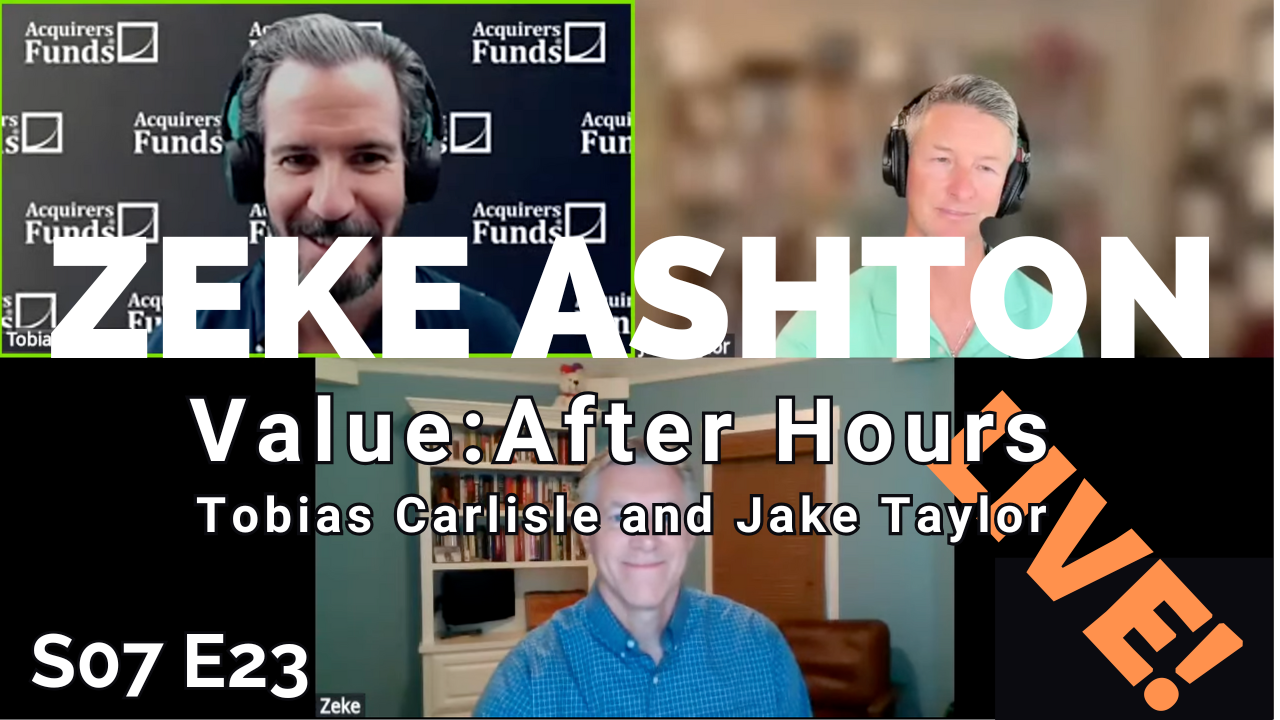
During their recent episode, Taylor, Carlisle, and Zeke Ashton discussed The Four Controllables in Investing. Here’s an excerpt from the episode:
Zeke: So, Toby, coming back to the investment process, I do want touch one thing with the few minutes of time we have left. This was something that I thought about probably about seven, eight years into being a professional investor. When I just took a step back and I said, “Well what are the things, what are the decision factors that I can control as an investor, and how can I get a little bit better at each of those and what are they?” It took me an embarrassingly long time to think about it, but I think the conclusion I came away with was there’s really only four things I can control when you’re talking about individual securities and decisions around them.
The first one is, what security should I buy? What should I own? The second one is, what price should I pay? And then, the third one, obviously, if it’s not at that price or below, then you don’t really have a choice of whether to buy it, unless you want to overpay. But the third one is, how big of my bankroll or my portfolio to make it? We discussed a little bit about bankroll management and portfolio management through the lens-
Jake: Kelly.
Zeke: -the Kelly formula last time we spoke. And then, the last one, which took me a long time to figure out, was on the sell side. I only have the choice to sell at today’s price or not, or hold on and hope I get a better price.
What I tried to do is, I had some very interesting insights when I wrote those four things down, because what I realized was paying the right price was usually not the make it or break it with a good investment or a bad investment. It was getting the right asset, buying an asset. About 90% of the time, it was making sure that I understood it really well enough and understood that it almost every time where I got sucked into buying an asset just because of the price. I got many good outcomes doing that, but I tended not to have the great outcomes. I had to be very quick to get out of the casino, if you want to call it that, before– This is more of the cigar bud type approach, the Ben Graham approach.
And then, the position sizing was an interesting one too. I have discovered there that I tend to not flex up and down position sizes maybe as much as I should when new information becomes available. I get incremental conviction one way or the other.
I think the part of that everybody struggles with more than anything is the selling. When do you sell businesses? When do you sell your stocks? This, I still don’t get it right a lot of the time. What I’ve come down to though, is that basically, if I was there for the price, primarily, if I was there because I thought I was getting a bargain security, then I need to get out when I get my price. If I’m really primarily there for the business, because I like the business, I have an affinity for the business and the management and I’m convinced they can continue to create value, then I actually need to let it go further and maybe even into the slightly overvalued realm before I sell it. So, I’ll leave you a little bit with that. We can jump off from there if you’d like and see where that goes.
Tobias: Yeah. That’s always been the difficulty for value guys, figuring out when to sell because you want to be conservative. So, when you see it getting closer to value, you feel like that’s the time to– At fair value, you’re saying you can get equivalent returns from something that is risk free, like you stick it into cash and you should be okay at that point.
But the reality, is that you buy these things, and then they start going up and so they get a little bit of momentum and you’re selling them right at the point that they’re getting maximum momentum or they’re about to have a really good year or so. And so, after doing all of the work and suffering through the sucky period, now that it’s come back and everybody loves it and it’s running, you’ve sold out and you’re gone, you moved on.
Zeke: Yeah. I think the other element of that is this is where the narrative transition takes place oftentimes. When you go from, “Oh, it’s cheap,” but everybody knows it’s cheap because it’s not very good to, “Oh, wait a minute, it’s a little better than we thought.” And then, “Oh, wait a minute, it’s pretty good.” We’ve probably seen this.
Again, really big stocks can do this, Walmart did it. Microsoft, probably the best example. It’s hard to look at Microsoft now and remember a time when people thought Microsoft was old tech and was really not relevant when you look at how dominant they are today.
And then, there are some things, like I think many of your guests have talked about Costco and how expensive that stock appears. I would argue that it’s simply being giving a huge premium for the fact that it’s just performed so well for so long, and it’s reached the point where people are saying, “Hey, there’s not really a price that’s too high to pay for that kind of quality,” whereas I would argue there is a price that’s too high to pay.
I think Costco is probably to the point where, “Hey, if you’ve owned it for a long time, you don’t want to take a tax gain on it,” sure, but if you were buying a stock today, I think you’d more likely be disappointed if you bought Costco at today’s price, but that’s just my view of that situation.
I do find that having gone through this exercise and realizing just how few points of control I really have made me want to get better control of those decision points and think about those things. I think the process of doing that made me a better investor. It certainly identified to me where some of my weaknesses are.
You can find out more about the VALUE: After Hours Podcast here – VALUE: After Hours Podcast. You can also listen to the podcast on your favorite podcast platforms here:

 Breaker

 Overcast


 RadioPublic


 Stitcher
